Walnut Meal for Bakery Systems: Absorption, Texture, and Consistency
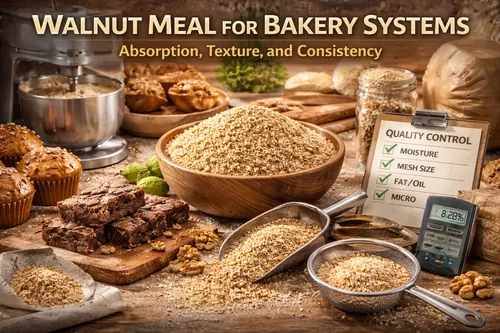
Industrial guide for walnut meal in bakery: how particle size, moisture, and fat content affect absorption, batter viscosity, crumb texture, and finished-product consistency—plus a practical specs checklist and packaging notes for bulk walnut meal programs.
Previous: Diced Walnuts for Bars and Snacks: Cut Size, Dust, and Line Performance • Next: Defatted Walnut Protein Powder: Applications in Nutrition and Dry Mixes
Related: bulk walnut products • products catalog • request a quote
Where walnut meal fits in bakery production
Walnut meal is a flexible format when you want walnut flavor and a “nutty body” without visible pieces. It’s commonly used to:
- Boost flavor and richness in cakes, muffins, quick breads, brownies, cookies, and bars.
- Modify texture (tender crumb, slightly denser bite, reduced “starch dryness”).
- Support clean-label positioning as a recognizable ingredient in premium or better-for-you lines.
- Improve distribution consistency versus pieces in high-speed mixing where inclusions can fracture.
Buyer note: the “same” walnut meal can behave very differently lot-to-lot if mesh/particle distribution, moisture, and fat/oil content aren’t controlled. That shows up as batter viscosity drift, yield changes, and texture variation.
Absorption basics: what drives hydration and viscosity
In bakery, “absorption” usually shows up as how walnut meal changes water demand and how fast a batter/dough tightens. Walnut meal contains fat and fiber/protein fractions that interact with water differently than wheat flour.
Key drivers of absorption
- Particle size / mesh: finer meal increases surface area and often increases perceived absorption and viscosity.
- Moisture of the meal: higher incoming moisture can reduce “net water available” and shift finished texture.
- Oil/fat content: higher oil tends to soften bite but can also reduce water-binding capacity (formula dependent).
- Process time: viscosity can rise after mixing as particles hydrate (especially in batters with rest time).
Practical processing tips
- Pre-blend with dry ingredients to prevent clumping and improve dispersion.
- Control rest time before deposit: if your batter sits, hydration can continue and thicken the system.
- Standardize mix energy (time and shear): over/under-mixing changes particle wetting and viscosity.
Texture outcomes: what walnut meal changes in the finished product
Walnut meal can shift both structure and eating quality. What you see depends on inclusion rate, mesh, base flour system, fat phase, and water activity targets.
Common effects (when used appropriately)
- Tenderness: a richer, softer bite in cakes and quick breads.
- Crumb character: a slightly denser, more “premium” crumb in brownies and bars.
- Flavor carry: more uniform walnut flavor distribution compared with pieces.
- Reduced visible defects: fewer “broken inclusion” complaints in high-speed processing.
Where issues appear (and what they usually mean)
- Dry/crumbly texture: meal too coarse for the formula, not enough water, or hydration time not accounted for.
- Gummy or tight crumb: over-hydration, overly fine meal, or long hold time before deposit.
- Oil bleed/greasy mouthfeel: fat phase imbalance, or meal with higher oil content than expected.
- Color drift: normal lot variability, or oxidation/age issues if paired with off-notes.
Rule of thumb: If you are chasing consistency, define the meal by a measurable spec (mesh distribution + moisture + fat) rather than by name alone (“meal” vs “flour”).
Consistency control: what to specify so your line runs the same
Walnut meal is often purchased under broad labels, but bakery performance depends on tighter controls. If you want fewer adjustments at the plant, these are the specs that usually matter most.
Specs that drive line behavior
- Particle size / mesh distribution: define a target and allowable range (not just “fine”).
- Moisture: keep tight enough to protect shelf life and prevent viscosity surprises.
- Fat/oil content: important for mouthfeel, deposit behavior, and oil migration risk.
- Fines / dust limit: affects handling, dusting, and hydration speed.
- Foreign material controls: critical for milled formats (metal detection + FM limits).
Specs that protect brand and QA outcomes
- Sensory: clean, nutty aroma; no rancid/off notes.
- Microbiology: align requirements to your category and kill-step assumptions.
- Allergen documentation: confirm statements and cross-contact posture.
- Country of origin + traceability: lot traceability and crop-year posture when relevant.
Oxidation and shelf-life: why walnut meal needs extra attention
Walnut fats are oxidation-sensitive. Milling increases exposed surface area, which can accelerate flavor drift if oxygen, heat, and light are not controlled. For bakery systems, this can show up as:
- Off-notes in the dry ingredient itself (fails incoming sensory).
- Shortened finished-product shelf life (stale/rancid note emerges earlier than expected).
- Greater lot-to-lot variability if age and storage history are inconsistent.
Risk reducers buyers can use
- Packaging posture: high-barrier packaging and sealed liners; nitrogen flush when available/appropriate.
- Storage posture: cool, dry storage; avoid prolonged warm staging.
- Freshness discipline: align purchasing and production so meal is used within your preferred window.
Packaging options for bulk walnut meal programs
Walnut meal is commonly shipped in sealed, lined bags or bulk bags depending on volume and plant handling. The right option depends on oxidation risk, receiving constraints, and whether you re-pack internally.
- Lined bags/cartons: practical for most plants; good for lot control and staged usage.
- Sealed bulk bags: for high-volume users; confirm liner/barrier level and handling controls.
- Drums/totes (less common for meal): sometimes used when additional barrier or handling protection is desired.
Operational tip: share your receiving setup early (dock constraints, pallet pattern, preferred net weight, liner requirements, and whether you need easy-open or reclose features). Packaging mismatches create avoidable delays.
How to request a quote with fewer back-and-forths
Walnut meal quotes move fastest when you specify how the ingredient must behave on your line. Include the details below to reduce iterations:
- Application: cookies, brownies, cakes, bars, fillings, etc. (and whether you have a kill step).
- Target particle spec: mesh/particle distribution or your internal “golden sample” reference.
- Moisture + fat targets: ranges you can tolerate without formula changes.
- Quality limits: FM, defect expectations, sensory requirements.
- Micro requirements: category-specific targets and documentation needs.
- Packaging: bag type, liner/barrier level, net weight, pallet pattern constraints.
- Volume + timing: first order, forecast, destination, and desired ship window.
Next step
If you share your bakery use case (product type, inclusion rate target, and whether you’re trying to replace flour or add flavor), we can recommend a practical walnut meal spec (mesh + moisture + packaging posture) and the fastest supply lane. Use Request a Quote or email contact@atlastradehouse.com.