Almond Meal for Meat Alternatives: Binding, Texture, and Label Considerations
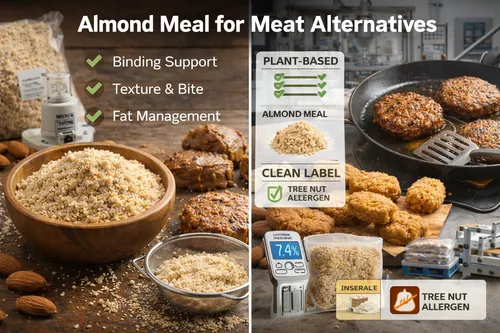
Almond meal can play multiple roles in meat-alternative systems: binding and water management, texture and bite, and fat handling—while supporting certain “recognizable ingredient” label strategies. This extended guide covers formulation logic, process checkpoints, and buyer-ready specs to protect line performance and shelf-life.
Previous: Almonds for Cereal and Granola: Roast Level, Crunch Retention, and Shelf Life • Next: Allergen Controls for Bulk Almond Programs: Receiving, Storage, and Labeling
Related: bulk almond products • products catalog • request a quote
On this page
- Where almond meal fits in meat-alternative formulations
- Functional roles: binder, texture builder, and fat-handling support
- Binding and water management checkpoints
- Texture and bite: selecting the grind for the desired eating quality
- Fat handling and “juiciness” perception
- Process checkpoints: mixing, pre-hydration, forming, and cooking
- Label and allergen considerations
- Format and spec checkpoints buyers should confirm
- Processing and shelf-life considerations
- Packaging options for bulk programs
- Receiving QA: quick gates that prevent defects
- Troubleshooting guide: symptoms, causes, and fixes
- Specs checklist (quote-ready)
- FAQ
- Next step
Where almond meal fits in meat-alternative formulations
In plant-based meat systems, almond meal is most often used as a supporting ingredient rather than a “main protein.” Its value is usually functional: helping a formed product hold together, manage water, and create a more convincing bite. It is commonly evaluated alongside other binders and texture builders (proteins, fibers, starches, hydrocolloids) as part of a system approach.
Typical targets where almond meal can help:
- Forming strength: improved cohesion in patties, balls, nuggets, cutlets, and crumble systems.
- Water control: reduced weeping during holding, thawing, and post-cook rest (process dependent).
- Texture balance: less “paste-like” eating quality and more natural heterogeneity.
- Fat distribution: improved stability of fat in the matrix in some formulations.
- Label strategy: potentially supports “recognizable ingredient” goals, but adds tree nut allergen obligations.
Practical note: the same “almond meal” can behave very differently depending on particle distribution, moisture, and how your process hydrates it—spec it like a functional ingredient, not a commodity.
Functional roles: binder, texture builder, and fat-handling support
When teams test almond meal in meat alternatives, the biggest wins are usually seen when the ingredient is assigned a clear job. Using it as an undefined “filler” often leads to inconsistent outcomes. Below is how the function typically shows up on the line.
1) Binder / water manager
Almond meal can contribute to structure by adding particulate solids that absorb and hold water in the matrix. Whether it behaves as a “binder” depends on hydration rate, mix energy, and the rest of the formulation. If hydration is incomplete, the matrix can crack or crumble. If over-bound (too fine or too high inclusion), the product can become dense and dry.
2) Texture builder (bite, heterogeneity, and chew perception)
Many plant-based products fail on texture because the matrix is too uniform. Almond meal can create controlled heterogeneity—small “particles” that read as bite. This is especially useful in patties or nuggets where consumers expect some fiber-like structure.
3) Fat-handling support
In certain systems, almond meal can help stabilize fat distribution and reduce surface greasing. The effect depends on fat type, process temperature, and mixing order. It is not a universal “fat binder,” but it can support a more stable matrix when used with the right grind and hydration approach.
Binding and water management checkpoints
Water is the hidden variable in many meat-alternative issues: purge in the package, weak forming, mushy bite, or dry texture after cooking. Almond meal influences water behavior through hydration rate and particle size distribution (PSD).
Hydration rate: the “mix-time tax”
Coarser meal hydrates more slowly. If your process relies on short mix times, you may see dry pockets or weak zones that crack during forming or cooking. Finer meal hydrates faster, but can increase viscosity quickly—raising torque, slowing mixing, and increasing the risk of over-binding.
Pre-hydration vs in-line hydration
- Pre-hydration approach: often improves consistency when using coarser meal or when hydration windows are tight. Helps reduce grit risk.
- In-line hydration approach: can work when PSD is controlled and mixing energy/time is sufficient, but is more sensitive to lot variation.
Batch-to-batch consistency and yield stability
In scaled production, drift typically comes from two places: moisture (ingredient water content) and PSD. Small changes can shift how much water the matrix “holds,” which changes yield, texture, and cook loss. If your KPI is yield stability, it’s worth tightening moisture windows and PSD control rather than adjusting water every batch.
- Hydration timing: confirm whether your process includes a rest time for water uptake.
- Moisture sensitivity: higher ingredient moisture can accelerate clumping and reduce dispersion consistency.
- Cook behavior: track moisture release, shrink, and purge; meal selection influences juiciness perception and firmness.
Buyer tip: if your product suffers from purge/weeping, tell the supplier your process step where water loss appears (post-mix, post-form, post-cook, or in-package). That helps determine whether you need a different grind, tighter moisture, or a process change.
Texture and bite: selecting the grind for the desired eating quality
Almond meal can deliver anything from subtle structure to noticeable grain. Select grind based on your target bite and the rest of the matrix. In meat alternatives, the goal is usually to create a convincing chew without introducing grit or causing dry bite.
Coarser meal / wider PSD
- More visible “bite” and heterogeneity
- Can improve chew perception in otherwise smooth systems
- Higher risk of grit if hydration time is short
- Higher segregation risk if vibration/handling is high
- Often preferred for “rustic” textures and nugget/coating systems
Finer meal / tighter PSD
- Smoother bite; more uniform matrix
- Often better dispersion in short-mix processes
- Higher clumping/bridging risk if moisture control is weak
- Higher surface area can increase oxidation sensitivity
- Often preferred where “grain” is undesirable (premium patties)
How to choose in practical terms
- If you need more bite: explore a slightly coarser meal or a broader PSD, but plan hydration/rest time to avoid grit.
- If you need smoother texture: move finer, but protect flowability and clumping with moisture control and better packaging.
- If your product is cracking: check hydration completeness and whether your PSD is too coarse for your mixing window.
- If your product is dense/dry: check whether you’re over-binding (too fine or too high inclusion) and whether you’re losing moisture during cooking.
Fat handling and “juiciness” perception
Many meat alternatives rely on fats to drive juiciness and mouthfeel. Almond meal interacts with fat through physical distribution and matrix stability. The effect can be positive (more stable distribution, less surface greasing) or negative (waxy/dry bite) depending on grind and process.
Where almond meal can help
- Distribution stability: particulate structure can help keep fat more evenly dispersed in some matrices.
- Grease control: may reduce “oil-out” on the surface in some processes (system dependent).
- Mouthfeel balance: can reduce a too-smooth/paste-like texture, improving perceived chew.
Where it can hurt
- Dry bite: if inclusion is high or grind is too fine, the matrix can feel dense or less juicy.
- Texture mismatch: overly coarse meal can read as “grain” instead of meat-like fiber, especially in thin patties.
- Oxidation sensitivity: higher surface area (finer) increases exposure risk—more important if fat system is also oxidation-prone.
Practical approach: define which “juiciness” problem you have—oil-out, dryness, or mushiness. Almond meal can help in some cases, but it must be paired with the right hydration and fat strategy.
Process checkpoints: mixing, pre-hydration, forming, and cooking
Meat-alternative performance is often decided by the process, not only the formulation. Almond meal is sensitive to hydration and handling, so the same ingredient can deliver different results depending on mixing energy, rest time, and forming method.
Mixing order (common production logic)
- Dry blend discipline: disperse meal uniformly before adding liquids to reduce lumping and pockets.
- Liquid addition control: add liquids consistently; uneven water addition can create clumps and inconsistent binding.
- Rest/hold step: if included, it can stabilize hydration and reduce batch variation.
Forming and handling
- Forming strength gates: test a small forming trial before committing a full batch if you’re switching lots or suppliers.
- Conveying/shear: excessive shear post-hydration can damage structure and increase smear, affecting bite.
- Freeze/thaw sensitivity: if you freeze products, hydration and binder strategy affects thaw purge and texture.
Cooking behavior
- Cook loss and shrink: track weight loss, purge, and texture change; adjust grind/hydration if loss is high.
- Surface browning: almond meal can influence color; align color expectations early for light products.
- Hold time: many defects show up after hot holding (drying, oil-out). Validate under real service conditions.
Label and allergen considerations
Almond is a tree nut allergen. That affects both labeling and the plant’s allergen-control burden. Align procurement with your brand’s allergen position and your co-manufacturer’s controls, especially if you run mixed-allergen lines.
Label strategy realities
- Recognizable ingredient: some brands prefer ingredients that read “familiar,” but performance must still be validated.
- Allergen disclosure: ensure your packaging and customer requirements match your target markets and channels.
- Customer expectations: foodservice and retail customers may have different allergen thresholds and documentation needs.
Allergen control burden
- Segregation: define storage zones and handling tools if your plant runs non-nut SKUs.
- Sanitation and changeover: align schedules and verification expectations.
- Supplier documentation: confirm allergen statements and any cross-contact notes required for your customers.
Buyer tip: decide early whether “contains tree nuts (almond)” is acceptable for your brand and customer base. If not, don’t build the system around almond meal—it’s not an ingredient you can “label around.”
Format and spec checkpoints buyers should confirm
For meat-alternative systems, the most common critical-to-quality (CTQ) items are grind/PSD and moisture—then color/defects and micro. If your line performance is sensitive, also discuss flowability and clumping risk.
Core specs to align (quote-ready)
- Grind target: mesh/PSD expectation; tolerance for grit vs smoothness; target “bite” description
- Moisture (and optionally aw): clumping control, flowability, and batch consistency
- Color/defect limits: appearance requirements, especially for lighter SKUs
- Micro requirements: align to your category and risk posture (program dependent)
- Flow characteristics: bridging/handling expectations for bins, hoppers, and augers
- Documentation: COA, traceability, COO, certifications if required
What to request when performance must be consistent
- PSD control plan: how often PSD is checked and what triggers adjustment.
- Method alignment: sieve profile vs PSD method—ensure both parties evaluate the same way.
- Lot-to-lot stability: ask for tighter windows if you run high-speed forming or short mix times.
Processing and shelf-life considerations
Almond meal contains oil and is sensitive to oxidation. Protect shelf-life by limiting oxygen/light/heat exposure in storage and during in-plant handling, especially if ingredient dwell time is long or if your distribution route includes warm warehousing.
Shelf-life risk drivers
- Storage: cool, stable conditions; avoid temperature cycling and warm warehouses.
- Handling: minimize open time, open-hopper dwell time, and rework loops that increase oxygen exposure.
- Packaging integrity: damaged liners and poor seals increase oxygen and moisture ingress.
- FIFO: align inventory turns to your flavor standard; don’t overbuy beyond practical shelf-life windows.
- Receiving checks: quick sensory/odor checks can prevent downstream flavor issues.
Shelf-life is often won or lost in the warehouse: even a great ingredient can drift if it sits warm or repeatedly exposed to air.
Packaging options for bulk programs
Bulk meal programs commonly ship in sealed lined bags or cartons. Packaging choice should match your receiving setup, humidity conditions, and handling method. If your plant is humid or you struggle with clumping, packaging barrier and reseal practices become more important than many teams expect.
- Lined bags/cartons: common for meal; confirm liner and barrier expectations as needed.
- Bulk bags: efficient for high volume; confirm discharge method and dust control expectations.
- Pallet constraints: share maximum height and footprint; confirm warehouse racking limits.
- Re-pack or blending: specify if you need smaller packs or particular liner compatibility.
Receiving QA: quick gates that prevent defects
A practical receiving protocol can prevent the most expensive failures: clumping that stops feeders, off-odors that ruin flavor, and documentation gaps that delay release. You don’t need a full lab to improve outcomes—consistent quick checks go a long way.
- Lot match: verify lot codes on packaging match COA and shipment documents.
- Packaging integrity: inspect seals and liners for damage or moisture exposure.
- Odor check: quick sensory gate for stale/rancid notes, especially after warm transit.
- Clump/flow check: if your line is sensitive, do a quick hand-flow check before staging for production.
- Color check: compare to internal reference if finished appearance is a CTQ.
Receiving tip: if the ingredient arrives warm, clumpy, or with damaged liners, quarantine early and document with photos + lot codes. Those conditions often predict flow issues and shortened shelf-life.
Troubleshooting guide: symptoms, causes, and fixes
Most issues map back to PSD (especially fine fraction), moisture exposure, or incomplete hydration. Use the guide below to speed root-cause work.
| Symptom | Likely causes | What to do (program dependent) |
|---|---|---|
| Cracking / crumbling during forming | Incomplete hydration, PSD too coarse for mix window, low binder system strength | Add pre-hydration or rest step; shift to finer/tighter PSD; standardize mixing order and liquid addition |
| Grit / sandy bite | Coarse tail too high, insufficient hydration time, low shear dispersion | Tighten coarse tail; extend hydration or add pre-hydration; increase mixing energy where feasible |
| Dense / dry bite | Over-binding (too fine or high inclusion), cook loss, insufficient fat/moisture retention | Reduce fine fraction or inclusion; adjust hydration; validate cook profile; review fat system and holding conditions |
| Purge / weeping in package | Water not bound/stabilized, freeze/thaw effects, formulation imbalance | Evaluate pre-hydration; adjust PSD; review water/fiber/starch balance; validate under freeze/thaw if applicable |
| Clumping / feeder issues | Moisture pickup, humidity swings, damaged liners, high fine fraction | Tighten moisture window; improve reseal practices; reduce open time; request tighter PSD (fewer ultra-fines); consider higher barrier packaging |
| Oil-out / surface greasing | Fat phase separation, temperature profile, insufficient matrix stability | Review fat type and process temperature; adjust mixing order; validate whether a different grind improves matrix stability |
Helpful supplier message: include symptom + process step, photos, lot code, receiving date, and what changed versus the last good run. That speeds root-cause and prevents repeated downtime.
Specs checklist (quote-ready)
To quote with fewer back-and-forths, include:
- Product: Almond meal (note whether you want “fine” or “coarse” behavior)
- Grind/PSD target: mesh expectations + texture tolerance (grit vs smooth) + target bite description
- Moisture (and optionally aw): clumping/flowability expectations; humidity risk notes
- Color/defect limits: appearance requirements
- Micro requirements: as applicable
- Packaging: bag/carton/bulk bag + pallet constraints + reseal expectations
- Volume: first order + forecast; delivery cadence
- Destination: city/state/country + required delivery window
- Documentation: COA, traceability, certifications if required
- Application: patty/nugget/ball/crumb + process notes (pre-hydration or not) + target bite/juiciness + freeze/thaw expectations (if any)
If your process is sensitive, add: “critical-to-quality = hydration rate, flowability, forming strength, and finished bite” so the program can target a tighter PSD window.
FAQ
Does almond meal replace methylcellulose or other binders?
Almond meal can support binding and texture in some systems, but it does not function identically to hydrocolloid binders. Most teams evaluate it as part of a binder system and validate forming + cook behavior under real process conditions.
How do I choose between a coarse and fine almond meal?
Choose based on your CTQ: if you need more bite and heterogeneity, go slightly coarser and plan hydration time. If you need a smoother matrix and short mix times, go finer/tighter PSD, but protect against clumping with moisture control and packaging.
What allergen label is required?
Almond is a tree nut allergen. Align your label language and allergen-control program with your target markets, customers, and co-manufacturer requirements.
What should I request on documentation?
Common requests include COA with lot traceability, allergen statements, country of origin, and micro documentation as applicable. For sensitive production, add PSD documentation (sieve profile or PSD method) and moisture/aw targets.
Next step
Share your product type (patty/nugget/crumb), target texture, and process constraints (mix time, hydration step, forming method, cook/freeze expectations). We can recommend a practical grind target and common spec checkpoints, then align packaging, documentation, and the best supply lane. Use Request a Quote or email contact@atlastradehouse.com.