
Almond Oil Roasting Programs: Oil Management, Seasoning Adhesion, and QA
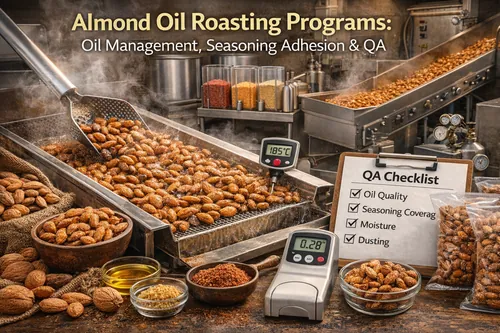
Oil roasted almonds are a high-throughput snack format that can deliver strong flavor carry, seasoning adhesion, and a glossy finish—but performance depends on tight control of oil quality, roast profile, and post-roast handling. This extended guide is written for procurement, QA, and R&D teams who need buyer-ready checkpoints to reduce rancidity risk, improve seasoning consistency, and scale reliable bulk programs.
Previous: In-Shell Almonds (Natural): Sorting, Moisture, and Export Considerations • Next: Using Almond Pieces in Bakery Fillings: Migration Control and Texture
Related: bulk almond products • products catalog • request a quote
On this page
- Where this format fits in production
- Key definitions buyers should align on
- Format and spec checkpoints (quote-ready)
- Process flow: what happens on a typical line
- Oil management: how stability is built
- Seasoning adhesion: reduce dusting and improve coverage
- QA checkpoints: in-process + finished-lot controls
- Shelf-life risk drivers and control plan
- Packaging options for bulk programs
- Troubleshooting: symptoms, causes, corrections
- Specs checklist (copy/paste)
- FAQ
- Next step
Where this format fits in production
Oil roasted almonds are commonly used in seasoned snack SKUs, trail mixes, bars, and foodservice garnish applications where sensory impact matters. Compared to dry roasting, oil roasting often increases surface “carry” (how strongly flavor hits in the first bite), improves seasoning pickup, and can produce a premium gloss. The tradeoff is that the surface system is more sensitive to oxidation and handling—so the program must be built as a complete system: almond format + roast profile + oil control + seasoning + cooling + packaging.
Common use cases
- Retail seasoned almonds: strong flavor profiles where adhesion and visual coverage are key.
- Ingredient inclusions: splits/pieces for snack mixes where “first bite impact” matters.
- Foodservice garnish: salads, bowls, and plated applications needing gloss and aroma.
- Private label programs: where lot consistency and documentation are critical.
Best fit vs. watch-outs
- Best fit: high-flavor profiles, strong seasoning adhesion, premium appearance, repeatable crunch.
- Watch-outs: rancidity risk, oil drift, seasoning dusting, texture variability when moisture and oil pickup move.
Practical rule: choose your priority first—maximum adhesion, clean mouthfeel, or maximum shelf-life—then build the roast + oil + packaging program around that priority.
Key definitions buyers should align on
Most disagreements in oil roasted almond programs come from definitions that were never aligned (or were aligned verbally but not written into the spec). The goal is simple: define what will be measured, how it will be measured, and what happens if it is out of range.
Oil pickup
Oil pickup is the amount of oil retained on (and to some extent in) the almond after roasting, draining, and cooling. It influences seasoning adhesion, mouthfeel (“rich” vs “greasy”), and oxidation rate. A program with a wide oil pickup range will almost always have wide variability in dusting and shelf-life.
Moisture vs water activity (aw)
Moisture measures total water content, while water activity (aw) describes how available that water is for reactions and quality drift. For roasted nuts, the operational meaning is usually crispness stability and resistance to softening in humid environments. If you ship into variable climates or store long, consider specifying aw or at least including packaging requirements that protect texture.
Roast profile vs roast color window
A roast profile describes how the product is cooked (time/temperature behavior and how the line achieves it). A roast color window is the acceptable surface appearance (and sometimes internal color) that signals whether the profile is hitting your flavor target. Color is often used as a proxy for flavor—helpful, but not perfect—so many strong programs combine color limits with a simple sensory reference standard.
Seasoning adhesion and dusting
Adhesion is how well seasoning stays on the almond through conveying, packing, shipping, and consumer handling. Dusting is the seasoning that falls off and accumulates in the bottom of the bag or carton. Specify dusting tolerance in plain terms: what you will accept visually, plus the in-pack residue expectation (bulk bags behave differently than retail pouches).
Buyer tip: request a one-page “CTQ definitions” attachment for your program. It reduces back-and-forth and makes audits easier.
Format and spec checkpoints (quote-ready)
A quote-ready program begins with the base almond format and the finished sensory target. Then you define the critical-to-quality items (CTQs) that must stay tight for your application to work. CTQs vary by use case: a retail snack SKU may prioritize seasoning adhesion and shelf-life; an inclusion may prioritize low dusting and consistent bite size; foodservice may prioritize gloss and aroma.
Base almond selection
- Format: whole, split, slivered, diced/pieces. Smaller pieces roast faster and can darken quickly.
- Size window: consistent sizing improves roast uniformity and reduces “mixed texture” outcomes.
- Grade/defects: set expectations for foreign material, insect damage, discoloration, and broken count.
- Incoming moisture window: impacts roast time, texture, oil pickup, and seasoning behavior.
- Micro program: confirm any pasteurization/category requirements and how lots are identified on COA/labels.
- Allergen posture: identify shared-line risks (other nuts, sesame, dairy powders, soy, wheat in seasonings).
Roast + surface system
- Roast color window: define light/nutty vs deeper/toasted outcomes; add photos or reference samples if possible.
- Oil system: oil type preference (if any), expectations for filtration/turnover, and changeover/cross-contact controls.
- Oil pickup target: a defined range (tight is better) aligned to mouthfeel and adhesion needs.
- Seasoning system: salt type/granulation, spice blend ownership (customer-supplied vs roaster-supplied), coverage expectations.
- Dusting tolerance: specify “maximum dusting allowed” and whether you mean bulk handling or retail pouch handling.
Recommended CTQ starter set
If you need a fast starting point, most bulk programs can begin with these CTQs: roast color window, oil pickup range, seasoning coverage + dusting tolerance, and packaging/barrier conformity. Then tighten moisture/aw and additional quality items as your program matures.
If shelf-life is critical, treat packaging as part of the roast program—not a separate line item. Barrier and sealing choices often matter as much as roast settings.
Process flow: what happens on a typical oil roasted almond line
Understanding the flow helps you predict where variability can enter—and what you should ask your supplier to control. While exact equipment differs, most oil roasting programs follow a similar logic:
- Receiving + staging: base almonds are verified against grade, defects, and moisture expectations.
- Pre-cleaning/inspection: removal of foreign material and excessive fines that can burn in oil.
- Oil roasting: almonds move through controlled hot oil exposure (continuous or batch) to develop texture and color.
- Draining/de-oiling: surface oil is reduced to hit the oil pickup window and avoid greasiness.
- Seasoning application: seasoning is applied while surface is warm/tacky; tumble controls impact coverage and break-off.
- Cooling + stabilization: product is cooled so it packs dry, crisp, and stable (reducing condensation and oxidation risk).
- Packaging: bulk bag/carton/retail pack; barrier selection and seal integrity strongly affect shelf-life.
- QA release: COA and documentation matched to lot codes; finished-lot checks verified.
Where most problems originate
- Oil drift: fines buildup, low turnover, or poor temperature control creates flavor/color drift over long runs.
- Surface mismatch: oil pickup too high or too low causes “greasy vs dusty” swings.
- Post-roast exposure: warm product sitting in air before packaging increases oxidation potential.
- Packaging errors: wrong liner/film, weak seals, or coding mistakes can turn a good lot into a short-shelf-life lot.
Oil management: how stability is built
Oil quality is the “hidden variable” in oil roasting. As oil ages, it can shift flavor, darken product, and accelerate oxidation. Strong programs control both oil condition (what the oil is like in the system) and oil carryover (how much oil ends up on the almonds).
Operational levers that matter
- Filtration discipline: removes fines that burn and drive off-notes and color drift.
- Turnover rate: consistent replenishment keeps oil closer to baseline sensory performance.
- Temperature stability: stable setpoints reduce over-browning and uneven texture.
- Changeover/cross-contact controls: prevent flavor carryover from strong spice runs (garlic, smoke, chili, cheese powders).
- Run scheduling: grouping similar flavors reduces contamination risk and sanitation burden.
What to ask a supplier (buyer-friendly)
- How often do you filter oil during production, and what triggers additional filtration?
- How do you manage oil turnover (make-up oil, refresh cadence, and criteria for full change)?
- How do you prevent seasoning fines from accumulating and burning in oil systems?
- How do you prevent flavor carryover between SKUs (especially spicy or savory profiles)?
- What’s your approach to documenting oil management actions for QA or customer audits?
Oil QA: practical checkpoints (program dependent)
Not all programs require lab-based oil testing, but all strong programs require repeatable monitoring and a clear corrective action path. For premium retail shelf-life targets or long exports, buyers may request deeper monitoring. Typical approaches include:
- Visual checks: oil color/clarity as a proxy for fines buildup and overheating risk.
- Sensory checks: odor/off-note detection at defined intervals during long runs.
- Process logs: temperature, filtration events, top-up events, and changeover procedures.
- Periodic lab metrics: where agreed, used to trend oil condition and guide refresh actions (program dependent).
Buyer tip: ask what triggers a corrective action (extra filtration, oil refresh, or scheduling changes). If the trigger is “operator judgment only,” expect variability.
Seasoning adhesion: reduce dusting and improve coverage
Adhesion is a balance between surface oil level, seasoning particle size, and post-roast handling. Too dry and seasoning falls off. Too oily and you get greasy mouthfeel, oily residue, and often reduced shelf-life. The goal is a repeatable “tack window” that holds seasoning through packaging and distribution.
Adhesion levers that usually matter most
- Oil pickup window: consistent surface tack without pooling.
- Granulation: fine particles adhere more easily; coarse particulates may require a binder approach.
- Application timing: apply seasoning while almonds are warm/tacky for better initial binding.
- Mixing intensity: too much tumbling can shear seasoning off after it sticks.
- Downstream handling: conveying, secondary mixing (trail mix), and shipping vibration can increase dusting if adhesion is marginal.
How buyers can write better adhesion specs
“Good adhesion” is subjective unless you define it. If adhesion is critical, consider including:
- Visual coverage target: examples or photos for “acceptable coverage.”
- Dusting tolerance: define “maximum dusting allowed” and whether you mean bulk carton residue or retail pouch residue.
- Seasoning ownership: confirm who supplies the blend and how lot-to-lot seasoning variability is managed.
- Salt type: fine vs flake, and acceptable substitutions if supply changes occur.
- Usage context: “standalone snack,” “trail mix inclusion,” or “re-pack into retail” affects how tough the adhesion must be.
If you struggle with seasoning settling at the bottom of the bag, treat it as a system issue: oil pickup + particle size + application timing + post-seasoning handling + packaging vibration profile.
QA checkpoints: in-process + finished-lot controls
Strong oil roasted almond programs combine in-process controls (catch issues mid-run) with finished-lot checks (ensure shipments meet receiving specs). The right plan depends on risk tolerance, customer category, and destination requirements.
In-process controls (roaster-side)
- Roast color checks at defined intervals (visual references or instrumented readings).
- Texture checks (bite/crunch reference) and adjustment notes if drift appears.
- Oil drift checks (odor/off-note) across long runs; triggers for filtration or refresh.
- Seasoning checks for coverage and dusting during packaging runs.
- Packaging verification (correct liner/film, seal integrity, lot coding accuracy).
Finished-lot items often requested on COA (program dependent)
- Moisture and/or aw when specified for texture stability programs.
- Defect/foreign material limits aligned to grade and customer tolerance.
- Micro requirements where applicable to the category and destination.
- Allergen statement and cross-contact handling posture (especially with flavored programs).
- Traceability elements: lot code format, production date, and trace-back identifiers.
Receiving checklist for buyers (simple but effective)
- Verify lot code match: carton/bag codes match COA and paperwork.
- Visual quick-check: color uniformity, foreign material, and “obvious” seasoning coverage issues.
- Dusting check: look for excessive seasoning residue in case liners or bags.
- Odor check: confirm no rancid/burnt notes on arrival, especially for long transit or hot climates.
- Storage conditions: keep stable temperature and protect from humidity to maintain crunch and shelf-life.
Shelf-life is often won or lost after roasting: warm packing, oxygen exposure, and poor storage conditions can undo a good roast.
Shelf-life risk drivers and control plan
Oil roasted almonds are more oxidation-sensitive than many teams expect because the surface oil increases oxygen contact area and carries volatile flavor notes. The main risk drivers are oxygen, heat, light, and time, plus how quickly product goes from roast to a stable, sealed package.
Post-roast cooling: the “silent” stability lever
Cooling is not just operational—it prevents condensation risk, reduces texture drift, and lowers oxidative reaction rate before sealing. If product is packed too warm, you can see softening, clumping of seasoning, and shelf-life loss even when everything else was done right.
Oxygen exposure and speed-to-seal
Think of oxygen exposure as a “clock” that accelerates when warm, oil-coated product is exposed to air. Minimizing this exposure window (and using appropriate barrier packaging) often delivers more shelf-life improvement than small roast tweaks.
Storage and distribution guidance (bulk programs)
- Temperature stability: avoid hot storage and frequent temperature swings; stability protects flavor and crunch.
- Humidity control: humid environments can soften texture and destabilize seasonings.
- First-in, first-out: inventory rotation matters more for oil roasted formats due to oxidation sensitivity.
- Export routes: long transit in warm conditions increases risk; align packaging barrier and logistics planning to route reality.
If you’re targeting long shelf-life retail packs, ask about barrier films/liners and any oxygen-control options (program dependent). Packaging is part of the roasting program.
Packaging options for bulk programs
Packaging should match your receiving constraints, inventory turns, and oxidation risk posture. For exports, consider both transit time and destination warehousing conditions. If you re-pack into retail, your bulk pack must protect the product until you open it.
Common bulk packaging formats
- Lined cartons / bags: common for kernels and roasted formats; confirm barrier needs and case pack.
- Bulk bags with liners: efficient for high-volume programs; confirm handling method and pallet constraints.
- Drums / rigid packaging: additional physical protection where handling risk is high or long storage is expected.
- Retail-ready / private label: plan MOQs, lead times, label requirements, and QA release workflow.
Packaging spec details buyers should provide
- Net weight per unit: and whether you need exact weights or a range.
- Case pack: number of units per case, pallet pattern, and maximum pallet height.
- Liner/film requirements: especially if you need higher oxygen or moisture barrier.
- Lot coding preferences: placement, readability expectations, and data fields required by your receiving SOP.
- Destination profile: shipping route and climate considerations (hot routes should be planned, not “hoped away”).
Share: pallet height limits, receiving equipment, re-pack requirements, and destination climate profile to avoid surprises.
Troubleshooting: symptoms, likely causes, and corrections
When oil roasted almonds underperform, the root cause is usually a small number of controllable variables. Use this list to accelerate diagnosis and communicate actionable corrective actions to your roaster or supplier.
1) Too greasy / oily residue in packaging
- Likely causes: oil pickup above target, insufficient draining/de-oiling, packing too warm, or inadequate cooling.
- Corrections: tighten oil pickup window; tune de-oiling step; verify cooling adequacy; reduce time between roast and sealing.
2) Seasoning dusting (residue at bottom of bag/carton)
- Likely causes: surface too dry, granulation too coarse, over-tumbling, harsh downstream conveying, high vibration shipping.
- Corrections: adjust oil pickup; refine seasoning particle size; change application timing; reduce post-seasoning handling.
3) Color too dark or inconsistent
- Likely causes: temperature instability, residence time drift, oil age/fines buildup, mixed almond sizing.
- Corrections: tighten size window; increase filtration discipline; stabilize temperature controls; define a narrower color window and sampling cadence.
4) Texture too soft / not crunchy
- Likely causes: insufficient roast development, high incoming moisture, humid handling environment, weak barrier packaging, warm packing causing condensation.
- Corrections: align incoming moisture window; improve cooling; strengthen packaging barrier; implement humidity controls where feasible.
5) Off-notes: stale, rancid, burnt, or “old oil”
- Likely causes: oil degradation (low turnover, burnt fines), prolonged oxygen exposure post-roast, high oil pickup, hot storage conditions.
- Corrections: clarify oil management triggers; improve filtration/turnover; reduce speed-to-seal time; strengthen barrier packaging; improve storage temperature stability.
A helpful corrective action request includes: the symptom, the lot code, the receiving date, what your team observed (photos help), and which CTQ you believe drifted (color, oil pickup, dusting, packaging).
Specs checklist (quote-ready)
If you have a spec sheet, send it. If not, copy/paste this checklist into your inquiry—this usually gets to a quote with fewer back-and-forths:
- Product: Oil roasted almonds (base format: whole / split / pieces)
- Grade & size: size window; defect/foreign material limits
- Roast profile: color window + sensory targets (light/nutty vs deeper/toasted)
- Oil system: oil type preference (if any) + oil pickup target range
- Seasoning: salt type/granulation; seasoning blend ownership; coverage expectation; dusting tolerance
- Moisture / aw: target range (if applicable) and texture expectation
- Micro: requirements + allergen handling expectations (as applicable)
- Packaging: bags/cartons; liner/film preference; case pack; pallet constraints
- Volume: first order + forecast; delivery cadence
- Destination: city/state/country; required delivery window; export documentation needs (if any)
If seasoning adhesion is critical, include: “maximum dusting allowed” and whether you’re packing bulk or retail—so the roaster can align the surface system.
FAQ
What’s the difference between oil roasted and dry roasted almonds?
Oil roasted almonds typically deliver stronger initial flavor carry, higher seasoning adhesion potential, and a glossy surface. Dry roasted formats can be easier to stabilize for long shelf-life when packaging is simpler, but may require different seasoning strategies to achieve the same coverage and mouthfeel. The “best” format depends on your product goals and distribution realities.
How do I specify “not greasy” while still getting good seasoning adhesion?
The practical approach is to specify an oil pickup target window plus a dusting tolerance. Then align seasoning granulation and application timing to that window. If you only say “not greasy,” the supplier may reduce oil too far and you’ll get dusting; if you only say “no dusting,” you may get a richer mouthfeel than you want. Balanced specs prevent swings.
What documentation is typical for bulk programs?
Common documentation includes COA, traceability elements (lot coding and production identification), allergen statements, and country of origin. Additional documentation may be available upon request depending on product and supplier program (for example, microbiology documentation where applicable or customer-specific compliance needs).
What should I tell a supplier if I’m exporting oil roasted almonds?
Provide destination climate and transit duration, your target shelf-life, and your packaging constraints. Export programs often require stronger barrier packaging and tighter control on speed-to-seal and storage temperature stability to protect flavor and crunch through long routes.
Next step
Share your application (snack SKU, ingredient inclusion, private label) and your target roast + seasoning outcome. We’ll confirm common spec targets, packaging options, and the fastest supply lane. Use Request a Quote or email contact@atlastradehouse.com.