
Almonds in Plant-Based Dairy: Base Building, Solids, and Stabilization Notes
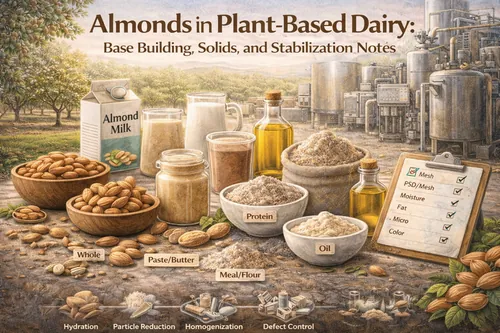
Almond ingredients can build clean-tasting plant-based dairy bases—beverages, creamers, yogurts, and frozen desserts— but performance depends on format choice (whole, paste/butter, meal/flour, protein, oil), solids management, and stabilization strategy. This guide highlights practical checkpoints that protect mouthfeel, reduce sedimentation and phase separation, and improve line consistency across hydration, milling, and heat treatment.
Previous: Refined vs Crude Almond Oil: Use Cases, Odor/Color, and Documentation • Next: Almond Ingredients for Ice Cream and Frozen Desserts: Preventing Graininess
Related: bulk almond products • products catalog • request a quote
What “plant-based dairy performance” usually means
Most almond-based dairy systems are trying to hit four targets at once:
- Stable dispersion: minimize sedimentation, creaming, and phase separation over shelf life.
- Clean mouthfeel: reduce grit and chalk while building “body” (especially in low-solids beverages).
- Process robustness: consistent viscosity through hydration, milling, homogenization, and heat steps.
- Flavor stability: prevent oxidation-driven flavor drift and protect “fresh almond” notes.
Buyer tip: treat almonds like an oil-containing ingredient. The biggest risks are particle size, emulsion control, and oxidation.
Format selection: which almond ingredient fits your base?
Whole/blanched almonds (wet-milled base)
- Best for: “from almonds” positioning, fresh flavor, customizable solids and fat.
- Watch-outs: requires soaking/hydration + wet milling; high risk of grit if particle reduction is insufficient.
- Key controls: hydration time/temperature, filtration strategy, and homogenization intensity.
Almond paste / almond butter (high-solids base building)
- Best for: creamers, yogurts, and rich beverage bases where fat + body are primary.
- Watch-outs: viscosity and oil separation behavior vary by grind and process; pumpability and tote handling matter.
- Key controls: viscosity target, particle reduction, and packaging/temperature management to limit separation.
Almond meal / flour (dry addition)
- Best for: dry-mix bases, blends, and formulations where you want almond solids with simpler supply/handling.
- Watch-outs: higher sedimentation risk if PSD is too coarse; fine flour can clump if moisture control is weak.
- Key controls: particle size distribution (PSD), moisture target, dispersion/hydration order, and shear.
Defatted almond protein / powders (body + protein positioning)
- Best for: protein-forward beverages and bases where fat must be controlled separately.
- Watch-outs: can add chalkiness or astringency if not balanced; hydration and shear are critical.
- Key controls: solubility/dispersion behavior, micro requirements, and flavor masking strategy if needed.
Almond oil (fat phase tuning)
- Best for: adjusting fat level and sensory without adding more solids.
- Watch-outs: stability depends on emulsification; refined vs cold-pressed choice affects flavor and color.
- Key controls: peroxide/FFA expectations (QA), filtration/refining notes, and packaging to limit oxygen/light exposure.
Solids: how almonds build body (and where they cause problems)
Almond systems typically balance three contributors:
- Fat phase: drives creaminess, lubricity, and richness (but needs emulsion control).
- Insoluble solids: drive body but also sedimentation and “grit” if particle size is too large.
- Stabilizers/structuring agents: manage suspension and viscosity (but can feel “gummy” if overused).
If you’re struggling with thin body, the fix is often not “more stabilizer” first—it’s usually better particle reduction, improved homogenization, or shifting to a higher-solids almond format (paste/butter).
Practical note: if you change almond flour/meal suppliers, validate PSD and moisture. Small shifts can change viscosity and sedimentation dramatically.
Stabilization notes (what to validate on the line)
Most stability problems come from two mechanisms: sedimentation (solids settling) and creaming (oil rising). Your process checkpoints should focus on controlling both.
Hydration and dispersion
- Order of addition: powders that hit water too fast can clump; pre-slurry or staged addition can help.
- Time + shear: coarse particles need time to hydrate; fine powders need enough shear to break agglomerates.
- Moisture sensitivity: higher ingredient moisture increases bridging/clumping risk in hoppers and feeders.
Particle reduction and filtration strategy
- Wet milling: target “no grit” sensory; validate with a simple bench mouthfeel check per batch.
- Filtration: improves smoothness but reduces yield/solids; decide early whether you prioritize yield or “dairy-like” smoothness.
Homogenization and heat treatment
- Homogenization: critical to control oil droplet size and reduce creaming.
- Heat steps: HTST/UHT can change viscosity and stability depending on the matrix; re-check separation after thermal processing.
Spec checkpoints buyers should confirm
Plant-based dairy bases tend to be sensitive. The most important specs depend on the format you buy:
- Whole kernels/cuts: moisture, defect limits, color, micro, and blanch/roast requirements (if applicable).
- Meal/flour: PSD/mesh targets, moisture, flowability/clumping expectations, color/defects, micro.
- Paste/butter: viscosity target (at defined temperature), oil separation expectation, particle reduction notes, sensory, packaging.
- Oils: sensory profile, filtration/refining notes, QA targets (oxidation indicators), packaging barrier expectations.
- Documentation: COA, traceability/lot ID, COO, allergen statement, certifications as required.
Processing and shelf-life considerations
Almond ingredients are oxidation-sensitive. The main shelf-life levers are oxygen exposure, temperature, light, and time. Bases with higher fat and longer distribution need tighter control.
- Storage: cool and stable; avoid warm warehouses and temperature cycling.
- Handling: minimize open time (powders in bins; pastes/oils in totes/drums).
- Receiving gates: quick odor/sensory checks can prevent downstream flavor issues.
- FIFO: align inventory turns with flavor standards and distribution timelines.
Packaging options for bulk programs
Packaging choice should match receiving method, humidity control, and inventory turns.
- Kernels/cuts: lined cartons or bags (confirm liner/barrier expectations if shelf-life is critical).
- Meal/flour: sealed lined bags/cartons; confirm dust and clumping controls for your plant environment.
- Pastes/oils: drums or totes; confirm pumpability, heating allowances (if any), and headspace/oxygen management expectations.
- Pallet constraints: share max height/footprint and dock equipment constraints early.
Specs checklist (quote-ready)
To quote with fewer back-and-forths, include:
- Application: beverage / creamer / yogurt / ice cream base (and process notes: wet-mill vs dry blend)
- Format: kernels / meal / flour / paste-butter / protein / oil
- Critical-to-quality: sedimentation control, emulsion stability, mouthfeel (no grit), viscosity target
- PSD/mesh or viscosity spec: depending on format
- Moisture target: especially for meal/flour
- Color/defect limits: as applicable
- Micro requirements: as applicable
- Packaging: bags/cartons/drums/totes + pallet constraints
- Volume: first order + forecast; delivery cadence
- Destination: city/state/country + required delivery window
- Documentation: COA, traceability, certifications if required
If your system is sensitive, add: “critical-to-quality = dispersion, sedimentation, and oxidative flavor stability” so the program can target tighter controls.
Next step
Share your product type (beverage/creamer/yogurt/frozen), target texture (thin vs creamy), and your processing flow (wet milling, filtration, homogenization, and heat treatment). We can recommend the most practical almond format and the spec checkpoints that protect stability and mouthfeel. Use Request a Quote or email contact@atlastradehouse.com.