Defatted Walnut Protein Powder: Applications in Nutrition and Dry Mixes
Defatted walnut protein powder (often produced from walnut press cake) is used when formulators want a walnut-forward protein ingredient with less oil than full-fat meal. Lower fat can improve dry blending, reduce oiling-off in mixes, and support higher protein positioning—while still requiring smart specs to manage flavor stability and dispersion.
Previous: Walnut Meal for Bakery Systems: Absorption, Texture, and Consistency • Next: Cold-Pressed Walnut Oil for Culinary Use: Sensory Profile and QA Checks
Related: bulk walnut products • products catalog • request a quote
What “defatted” changes (and why buyers use it)
Removing a portion of the oil typically shifts the ingredient from “nut meal” behavior toward “protein flour” behavior. In practice, defatting can improve dry handling and reduce greasiness, but it can also increase water uptake and make dispersion and mouthfeel more sensitive to particle size.
- Higher protein density per kilogram versus full-fat meal.
- Lower oil contribution to finished systems (less oil separation/oiling-off).
- More powder-like flow in dry mixing and packaging.
- Greater surface area exposure (depending on milling), which can influence flavor stability.
Buyer shortcut: Ask for both protein % and residual fat %, plus particle size/mesh. Those three fields explain most performance differences between “defatted walnut powders.”
Where this format fits best
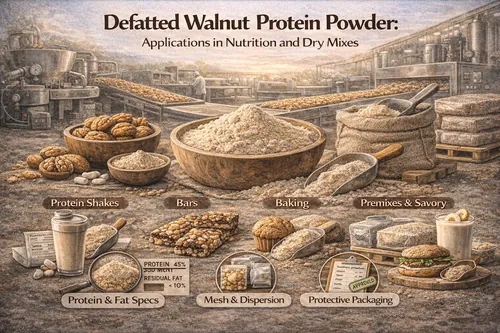
Defatted walnut protein powder is most commonly positioned as a nutrition and dry-mix builder, and as a functional dry ingredient where you want walnut identity without the full oil load of meal or butter.
- Protein powders & dry beverage mixes: walnut identity + plant protein blend building.
- Bars: binder interaction and protein boost; helps reduce greasy handling versus full-fat inclusions.
- Baking mixes: partial flour replacement for nut flavor + protein positioning.
- Seasonings & savory dry mixes: nutty backbone for sauces/dressings when hydrated.
Formulation notes for nutrition and dry mixes
The main performance questions in nutrition and dry mixes are dispersion, mouthfeel, and flavor stability. Powder specs (especially mesh/PSD and residual fat) strongly influence all three.
- Dispersion: finer powders disperse faster but can dust more; coarser powders can feel gritty.
- Mouthfeel: very fine milling can reduce grit but may increase perceived dryness.
- Hydration behavior: defatted powders often bind water; plan mixing order and water phase intensity.
- Flavor balancing: walnut notes can read “toasty/bitter” at higher inclusion—masking and sweetness systems matter.
If you are targeting RTD (ready-to-drink) style mouthfeel, treat particle size and rehydration as first-class specs—not afterthoughts.
Processing and shelf-life considerations
Even after partial defatting, walnut-derived powders remain sensitive to oxidation. Shelf-life performance depends on oxygen exposure, heat, light, and how long the powder is held open after packaging is breached.
- Oxidation risk increases with higher surface area and longer storage in warm lanes.
- Residual fat is still a key driver of rancidity risk—don’t assume “defatted” means “stable.”
- Hold-time control: define a “use within X days of opening” internal policy for production staging.
- Finished product interaction: high water activity systems can shift flavor faster than dry systems.
Format and spec checkpoints buyers should confirm
For defatted walnut protein powder, buyers typically confirm:
- Protein % target and acceptable range.
- Residual fat % target and max (definition of “defatted” varies by program).
- Moisture target + max (flow, clumping, and storage safety).
- Particle size / mesh / PSD (mouthfeel and mixing behavior).
- Micro requirements appropriate to your use case (especially for nutrition applications).
- Sensory: color range and acceptable bitterness/toast notes; define rancid/off-note rejection criteria.
- Allergen statement & COA fields: ensure the COA includes the measures your QA team will release against.
Packaging options for bulk programs
Bulk powder programs often use sealed bags (sometimes in cartons) or bulk sacks depending on volume. Confirm your receiving setup, dust controls, and how you stage open bags in production.
- Sealed inner liner is common for powders to manage moisture pickup and odors.
- Share constraints early: pallet height limits, repack needs, and warehouse temperature range.
How to request a quote with fewer back-and-forths
For defatted walnut protein powder, the fastest quote path is to include:
- Application (protein mix, bar, bakery premix, savory dry mix) and any mouthfeel/dispersion constraints.
- Protein target, residual fat target/max, moisture target/max.
- Mesh/PSD requirement and flow expectations.
- Micro requirements and any documentation needs (COA fields, allergen, COO, certifications if applicable).
- Packaging preference, first order volume, annual forecast, destination, and timeline.
Next step
If you share your end-use (nutrition powder vs bar vs premix), target protein level, and preferred mesh/PSD, we can propose a practical spec set (protein/residual fat/moisture/micro/mesh) and packaging lane that reduces dispersion and shelf-life surprises. Use Request a Quote or email contact@atlastradehouse.com.