
How to Request a Quote for Bulk Walnut Products: The Spec Sheet Buyers Use
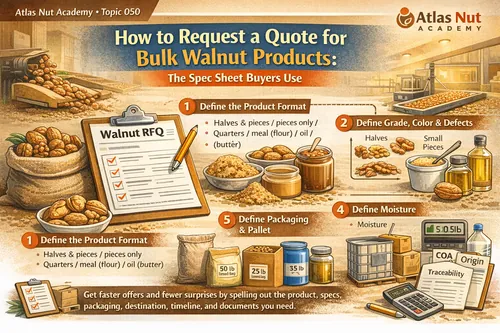
Industrial guide for how to request a quote for bulk walnut products: the spec sheet buyers use. If you've ever asked for “walnut pieces” and received three different prices and three different interpretations, this page is the fix. Below is the RFQ structure procurement teams use to make quotes comparable: define the format, define the quality window, define the packaging, and define the lane (destination + timeline). Do that, and you get faster offers, fewer revisions, and fewer surprises at receiving.
Previous: Retail Packaging Programs for Walnuts: Private Label and QC Points • Next: California Almond Varieties Buyers Should Know: Nonpareil and Beyond
Related: bulk walnut products • products catalog • request a quote
Fast rule: A quote is only as good as the spec. If your spec is vague, you will get a “placeholder” price and a second round of questions. If your spec is complete, suppliers can quote a firm lane, plan inventory, and match a lot to your requirements.
Table of contents
- Why the spec sheet matters (and why quotes vary)
- Step 1 — Define the product format
- Step 2 — Define grade, color, and defect limits
- Step 3 — Define moisture and shelf-life expectations
- Step 4 — Define food safety & microbiology requirements
- Step 5 — Define packaging, pallet, and receiving constraints
- Step 6 — Define destination, lead time, and buying structure
- Step 7 — Define documentation and compliance needs
- Copy/paste RFQ templates (email + form)
- How to compare quotes fairly
- Common mistakes that cause delays
- FAQ
- Next step
Why the spec sheet matters (and why quotes vary)
Bulk walnut programs are not one commodity. Pricing changes with format, color, defect tolerance, moisture target, packaging, and lane. If you leave any of these undefined, suppliers fill the gaps differently. That creates “apples-to-oranges” quotes.
A complete spec sheet does three things:
- Makes offers comparable: suppliers are quoting the same product window.
- Reduces receiving disputes: QA and procurement share a clear acceptance definition.
- Reduces lead time risk: suppliers can match inventory and plan processing to your needs.
Step 1 — Define the product format
Start with what your line needs. Different formats behave differently in production, and that affects yield, labor, and overall finished cost. Your quote should specify the format explicitly, not just “walnuts.”
Common bulk walnut formats buyers request
- Walnut kernels (halves and pieces): used in bakery, cereals, snack mixes, and confectionery.
- Pieces only: more uniform functionality and cost efficiency for inclusion products.
- Quarters / large pieces / small pieces: used when a specific visual size drives finished-product perception.
- Meal/flour: for bakery blends, coatings, fillings, and plant-based applications.
- Walnut oil / walnut paste / walnut butter: for flavor systems, spreads, sauces, and specialty foods.
- In-shell walnuts: often export or retail presentation driven; different specs and packaging apply.
Format details that change pricing and lead time
- Cut/size specification: define what “pieces” means (large/small or screen/mesh approach, program dependent).
- Roasted vs raw: if roasted, specify roast style and any seasoning requirements.
- Intended use: bakery vs snack vs confectionery changes which defects matter most.
Shortcut: If you are unsure what format you need, describe the application and the equipment (mixing, depositor, extruder, topping line). A supplier can suggest a format that reduces processing steps on your side.
Step 2 — Define grade, color, and defect limits
Walnuts are commonly specified by color range and defect tolerances because these factors determine sorting intensity and usable yield. If you leave them vague, suppliers will quote different quality windows.
Color: why it matters
Color is a proxy for appearance and, in some channels, perceived freshness. If your product is consumer-visible (snack packs, bakery toppings), tighter color targets can be worth it. If walnuts are baked into a product or milled, you may not need the tightest window.
Defects: define what matters for your application
Buyers should specify defect categories that can cause consumer complaints or line issues. Depending on program, defects may include: insect damage, dark pieces, shriveled kernels, shell fragments, foreign material, and other condition concerns. The critical point is to define tolerances and inspection method so both sides measure the same thing.
Practical buyer approach: “target + acceptable range”
For many industrial programs, the best spec structure is a target window plus an acceptable range: tight enough for performance, but not so narrow that availability becomes fragile.
Step 3 — Define moisture and shelf-life expectations
Moisture influences texture, storage stability, and the risk of quality drift during transit. It also interacts with oxidation risk—especially if product will see heat exposure or long dwell times.
What to include in your spec
- Moisture target: your acceptable range and test method expectations (program dependent).
- Storage plan: ambient vs cool storage, expected dwell time, and rotation approach (FIFO).
- Shelf-life requirement: your finished-product shelf-life target and how walnuts fit into that plan.
Buyer lens: If you ship long distances or store inventory for months, ask about packaging barriers and storage conditions. Shelf life is not just the product—it’s the product + packaging + warehouse discipline.
Step 4 — Define food safety & microbiology requirements
Food safety requirements differ by customer, channel, and geography. A quote can change if your program requires specific testing, validated interventions, or additional documentation. Define what your QA team needs up front.
Common buyer requirements (program dependent)
- Microbiology targets: specify which tests are required and whether you need lot-by-lot results.
- Allergen program expectations: cross-contact controls, labeling, and statements.
- Traceability: lot code structure and recall readiness.
- Third-party audits: if required for your customer program, include that in RFQ notes.
Note: requirements vary by market and customer. The best RFQs attach the internal spec sheet or list required tests and documents explicitly.
Step 5 — Define packaging, pallet, and receiving constraints
Packaging changes cost, shelf life, damage risk, and freight efficiency. It also affects how quickly product can be received and staged in your facility. If your packaging is not defined, you will often receive a quote that later needs revision.
Common bulk packaging options (kernels/pieces)
- Lined bags: common for industrial use; define net weight and liner type as needed.
- Cartons: can improve stacking and handling; useful for certain warehouse layouts.
- Barrier / oxygen-reducing options (program dependent): used when shelf-life sensitivity is high.
For oils/pastes/butters
- Pails/drums/totes: define lining, headspace, and whether you require nitrogen flushing or specific seals.
- Temperature controls: confirm acceptable storage and transit temperatures to avoid separation or off-notes.
Pallet and receiving details that avoid headaches
- Pallet height and weight limits: align to your dock equipment and racking.
- Container or truck loading preference: affects damage risk and unloading speed.
- Label requirements: lot codes, item numbers, country of origin, and customer-specific markings.
Step 6 — Define destination, lead time, and buying structure
A quote should be tied to a lane: where it’s going, when you need it, and whether you are buying spot or building a program. Freight availability, seasonal demand, and lead times can change landed cost materially.
Lane details to include
- Destination: city/state/country, delivery point, and whether you need export documentation.
- Timeline: requested ship window and required arrival date.
- Volume structure: one-off order vs recurring shipments; forecast if available.
- Incoterms (if applicable): clarify responsibility boundaries and cost basis.
Spot vs forward: what to tell suppliers
If you want spot pricing, say so. If you are building a program, provide a forecast. Forecasts allow suppliers to plan processing and inventory, which can improve availability and sometimes pricing stability.
Step 7 — Define documentation and compliance needs
Documentation is often the hidden reason quotes slow down. If a supplier must assemble a specific document set, confirm it in the RFQ. This is especially true for export lanes or regulated customer programs.
Common documentation requests (program dependent)
- COA: aligned to your spec (moisture, defects, and required tests).
- Microbiology documentation: where required by your QA program.
- Allergen statement: and any cross-contact declarations needed.
- Country of origin: and supporting origin statements if needed.
- Lot traceability details: how lot codes map to packaging and shipping documents.
- Export documents: market-dependent certificates and labeling support as needed.
Simple win: Add a bullet list titled “Required documents” to every RFQ. You’ll cut a full cycle of emails.
Copy/paste RFQ templates (email + form)
Email RFQ template (fast)
Subject: RFQ – Bulk Walnuts (format + spec + destination)
Product: Walnut [halves & pieces / pieces only / quarters / meal / oil]
Use case: [bakery/snack/confectionery/ice cream/etc.]
Color target: [target + acceptable range]
Defect limits: [key limits that matter to you]
Moisture target: [target + acceptable range]
Food safety/micro: [tests required, if any]
Packaging: [bag/carton/drum], net weight, pallet preferences
Volume: first order + annual forecast (if available)
Destination: [city/state/country], requested ship window
Documents: COA + [origin/allergen/micro/etc.]
Notes: receiving constraints (pallet height, unloading method), any label requirements
Request-a-Quote form template (compact)
- Product + format: walnut [format]
- Spec targets: color, defects, moisture
- Packaging: type + net weight + pallet notes
- Volume: initial + forecast
- Destination + timeline: where/when
- Docs: COA + additional needs
How to compare quotes fairly
Before you decide one price is “better,” confirm the quotes match on these fields:
- Same format and cut size (halves & pieces vs pieces only can be materially different).
- Same color and defect window (tighter window usually costs more).
- Same moisture target and packaging barrier (shelf-life protection changes value).
- Same destination and lead time (freight can dominate differences).
- Same documentation set (export docs and testing can add cost and time).
If one quote is lower but also less defined, treat it as a preliminary range until the spec is aligned.
Common mistakes that cause delays
- Asking for “walnut pieces” without defining size and color window — suppliers fill in the blanks differently.
- Not stating destination and timeline — availability and freight cannot be planned accurately.
- Sending volume without forecast context — suppliers can’t plan program support.
- Leaving packaging undefined — palletization, shelf-life, and damage risk aren’t aligned.
- Adding documentation requirements late — creates a second quote cycle and can delay shipment.
FAQ
Do I need to attach a spec sheet?
If you have one, yes—attach it. If you don’t, the templates above cover the fields needed to get an accurate quote. The goal is to define the quality window so offers are comparable.
What if I’m not sure about color or defect targets?
Describe the application and whether walnuts are visible to consumers. Many industrial users can accept a practical range that improves availability and lowers cost without impacting finished-product performance.
How far in advance should I request pricing?
For spot needs, as early as possible—especially before seasonal demand spikes. For recurring programs, request pricing with enough time to align specs, qualify documentation, and plan logistics.
Next step
If you share your application and the format you need, we can confirm common spec targets, packaging options, and the fastest supply lane. Use Request a Quote or email contact@atlastradehouse.com.
To speed things up, include: format (halves/pieces/meal/oil), color target, defect limits, moisture target, packaging, first volume + forecast, destination, requested ship window, and required documents (COA + any program-specific items).