
Retail Packaging Programs for Walnuts: Private Label and QC Points
Industrial guide for retail walnut packaging programs (private label): packaging choices, label workflow, shelf-life controls, and the QC points that reduce complaints and rework. Built for buyers converting bulk walnut supply into retail-ready packs.
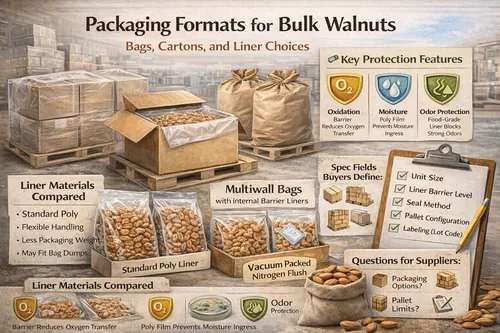
Previous: Packaging Formats for Bulk Walnuts: Bags, Cartons, and Liner Choices • Next: How to Request a Quote for Bulk Walnut Products: The Spec Sheet Buyers Use
Related: bulk walnut products • products catalog • request a quote
What a “retail packaging program” actually includes
Retail private label is rarely “just pack it into a bag.” A program typically combines: (1) a defined walnut format and grade, (2) packaging materials and pack style, (3) label and regulatory workflow, (4) QC + traceability controls, and (5) a supply plan that matches shelf-life and retail replenishment cycles.
Buyer goal: reduce surprises. Retail programs fail from small mismatches—wrong defect tolerance, weak barrier film, unclear label approvals, or unrealistic lead times.
Where this format fits in production
Retail packs sit between bulk procurement and consumer expectations. Your walnut spec must support both: consistent appearance and flavor and a cost structure that survives retail pricing. Start with your target use case—snacking, baking, salad topper, cooking—and choose the format that supports it.
- Snack-focused: higher appearance expectations, stronger emphasis on flavor freshness.
- Baking-focused: size distribution matters; appearance is secondary to consistency and value.
- Multi-use retail SKU: needs balanced spec, tighter defect controls, and robust packaging barrier.
Format selection for private label walnuts
The fastest way to lock a program is to pick a format that aligns with consumer expectations and your margin model. Most retail programs select from:
- Halves & pieces: “premium look” mix; good for snack + baking.
- Pieces (size-defined): improves pack appearance consistency and reduces customer complaints about “too many crumbs.”
- Chopped: value-oriented baking SKU; more forgiving visually but needs strong FM control.
- Meal/flour: specialty baking; different shelf-life and handling needs (flow, moisture control).
Tip: If you’re early-stage, qualify one “core” spec and one “value” spec. This gives you a pricing lever without restarting the program.
Packaging styles buyers use (and why)
The packaging decision is a shelf-life decision. Walnuts are sensitive to oxidation; oxygen exposure, heat, and light accelerate off-flavors. Choose packaging to match shelf-life target, retail channel, and expected inventory dwell time.
Common retail pack formats
- Stand-up pouch (SUP): strong shelf presence; can support reseal features; widely used for nuts.
- Pillow bag: cost-efficient; typically less premium shelf appearance.
- Rigid canister/jar: premium feel; higher material cost; can improve handling protection.
- Club formats: larger sizes with focus on value and consistent fill performance.
Barrier and oxygen control (high-level)
Retail walnut programs often succeed or fail based on barrier selection and seal integrity. Higher oxygen barrier films and careful filling practices typically improve flavor stability, especially for longer shelf-life targets. Some programs also use modified atmosphere approaches where appropriate.
Practical lens: If the product will sit in distribution + retail for months, prioritize barrier and seal performance. If you turn inventory quickly, you may be able to optimize cost without increasing complaint risk.
Private label workflow: what causes delays
Packaging projects often slip due to approvals and change control. Build the workflow into your timeline.
Typical steps
- Pack spec + label content: net weight, ingredients (if blends), allergen statements, storage guidance.
- Artwork + proofing: confirm dielines, barcode placement, legibility, and mandatory label items.
- Compliance review: internal QA/regulatory sign-off; retailer requirements (if applicable).
- Packaging procurement: lead times for film/labels, minimum order quantities, changeover rules.
- First run + retention: validate weights, seals, date coding, and finished pack appearance.
Two common failure points
- Late changes to label content: forces film/label reprint and pushes production.
- Unclear master case/pallet needs: creates warehouse receiving issues and rework costs.
QC points that matter most in retail walnut programs
Retail QC isn’t only about passing COA. It’s about preventing consumer complaints: rancidity, stale flavor, foreign material, inconsistent size distribution, or poor pack appearance.
Raw material QC (before packing)
- Defect limits: define what “acceptable” means for your SKU (appearance vs value positioning).
- Color/appearance: align to your brand promise (especially for “premium” SKUs).
- Foreign material controls: clarify critical limits and inspection method expectations.
- Moisture targets: align to storage safety and texture expectations.
- Micro requirements: match your category risk posture and customer requirements.
In-process QC (during packing)
- Checkweighing: control net weight variance; define rework rules.
- Seal integrity: verify seal strength/consistency; define sampling frequency.
- Metal detection / X-ray: if used, validate sensitivity and verification cadence.
- Date code accuracy: lot/date coding must support traceability and recall readiness.
Finished goods QC (after packing)
- Sensory checks: smell/taste for freshness and off-notes; retain reference samples per lot.
- Pack appearance: settling, breakage, and “dust” levels should match expectations.
- Case and pallet integrity: prevent damage in transit (especially for export lanes).
Complaint reduction tip: Define a written “rancidity / stale flavor” process: retain samples, define investigation steps, and connect sensory findings to lot, packaging, and storage history.
Shelf-life planning: align reality to the label
Shelf-life isn’t only a date on the bag—it's a promise influenced by oxygen exposure, storage temperature, and retail handling. If you target longer shelf life, you typically need stronger packaging controls and tighter inventory discipline.
- Storage alignment: confirm warehouse temperature and humidity expectations with your risk posture.
- Transit time impact: long routes increase both time and temperature exposure risk.
- Rotation discipline: define FIFO/FEFO rules in distribution.
Specs checklist buyers should confirm (private label)
To reduce back-and-forth, lock these items early:
- Product: walnut format, grade, size distribution target.
- Quality: defect limits, color expectations, foreign material controls.
- Moisture + storage: targets and receiving method; storage expectations.
- Micro: category requirements and test method expectations.
- Packaging: pack style, net weight(s), barrier expectations, reseal features (if any).
- Label: artwork owner, approval process, and change control rules.
- Logistics: case pack, pallet configuration, destination, incoterms (if export).
- Volume: first run size, annual forecast, and seasonality.
- Timeline: target ship date and lead-time constraints.
How to request a quote with fewer back-and-forths
Send: product + format, grade/size, defect limits, moisture target, packaging format + net weight, barrier/oxygen control preferences, initial order volume, annual forecast, destination, and timeline. If you have a pack spec or label requirements, attach them.
Next reading: How to Request a Quote for Bulk Walnut Products: The Spec Sheet Buyers Use
Next step
If you share your retail SKU goals (pack size, channel, shelf-life target) and your preferred walnut grade/format, we can help map packaging options, QC points, and the most stable supply lane. Use Request a Quote or email contact@atlastradehouse.com.