Pest and Disease Pressure in California Almonds: What Affects Grade
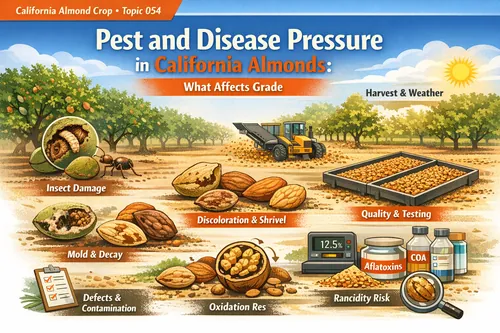
California almond crop & harvest guide: pest and disease pressure in California almonds and what affects grade. Learn how orchard conditions and post-harvest handling influence moisture, insect damage, mold risk, foreign material controls, kernel appearance, and procurement planning for bulk almond programs.
Previous: Orchard Irrigation and Water Stress in Almonds: Quality and Yield Impacts • Next: Harvest Timing for Almonds: Hull Split, Shaking, and Field Drying
Related: bulk almond products • products catalog • request a quote
Overview: what “pest and disease pressure” means in industrial buying
In almond sourcing, the phrase pest and disease pressure is shorthand for how much biological stress the orchard experienced during the crop year and how likely that stress is to show up as measurable defects and grade variability. Buyers rarely reject a lot because a pest name is mentioned. They reject a lot because the lot arrives with:
- Higher insect damage than expected (and more sorting burden downstream).
- Mold/decay indicators or off-odors that don’t fit the application.
- Appearance drift (discoloration, staining, chipped kernels) that conflicts with a customer spec.
- Moisture variability that threatens shelf life, especially for long transit lanes or slow-turn programs.
- Foreign material risk that forces tighter receiving and rework decisions.
Procurement goal: translate crop-year variability into a controlled supply lane. That means aligning on specs (defects + moisture), documentation (COA + traceability), and the handling steps that protect the product between harvest and your warehouse.
Why crop and harvest details matter to buyers
Almonds are a low-moisture, high-fat ingredient. That combination is excellent for storage stability when handled well—but it also means quality problems can hide until later in the supply chain. Pest and disease pressure influences what buyers care about most:
- Grade consistency: predictable lots that repeatedly meet customer expectations reduce downtime and complaints.
- Defect rates: insect damage, mold/decay presence, chips/breakage, and discoloration drive acceptance decisions.
- Edible yield in processing: higher defects and variability increase sorting load and reduce yield to your target format.
- Shelf-life performance: damaged kernels oxidize faster; moisture history and storage conditions influence rancidity risk.
- Food safety posture: orchard-to-plant sanitation and post-harvest controls influence risk management expectations.
Understanding the basics helps buyers interpret offers, plan buffers, and align the right format to the right application (snacking vs bakery vs confectionery vs nut butter vs beverage base).
Key steps in the field-to-warehouse flow
A strong almond lot is the result of a chain of decisions and conditions. Issues often “stack”: orchard pressure + delayed harvest + marginal drying or storage can turn manageable variability into a measurable defect problem.
- Orchard management: irrigation, nutrition, canopy health, orchard sanitation, monitoring.
- Bloom and set: timing affects vulnerability windows for certain diseases and insects.
- Growing season conditions: heat, humidity, and rain events influence disease pressure and stress.
- Harvest operations: shake timing, minimizing ground contact time, and orderly pickup.
- Drying: controlled moisture reduction to stabilize the crop.
- Hulling/shelling: program dependent; influences foreign material and kernel integrity.
- Sorting/grading: removal of defects and foreign material; grade classification and lot consistency.
- Warehousing and shipping: temperature, humidity, oxygen exposure management; traceability and FIFO discipline.
Buyers typically don’t need every agronomy detail. They need the parts that show up as measurable acceptance criteria: moisture, defects, appearance, and documentation.
How pest and disease pressure becomes grade outcomes
Think of pest and disease pressure as a defect generator and a variability amplifier. Some issues create direct defects (insect damage). Others increase vulnerability (hull integrity damage) that leads to more discoloration, decay risk, or sorting burden.
Buyer-visible outcomes that affect grade and price
- Insect damage categories: more damaged kernels reduce grade consistency and increase rejects in sensitive applications.
- Discoloration and staining: impacts appearance-driven SKUs and can shift grade perception.
- Chips/breakage: increases variability in kernels/halves programs and changes performance in inclusions.
- Mold/decay presence: triggers sensory complaints, shelf-life risk, and potential rejections.
- Foreign material: shell fragments and debris increase receiving scrutiny and risk costs.
- Moisture variability: destabilizes shelf life and can increase quality drift in storage.
Risk map: what to control as a buyer
| Upstream driver | What buyers see | Why it matters | Controls to request |
|---|---|---|---|
| Insect feeding / shell entry | Insect damage counts, more rejects | Yield loss, more rework, faster oxidation risk | Defect limits, supplier lot history, sorting controls |
| Hull integrity problems | Staining, discoloration, higher variability | Appearance-grade risk and customer perception | Appearance targets, grade definition, reference samples |
| Wet events / delayed harvest | Moisture variability, musty risk | Shelf-life drift; mold/decay risk | Moisture spec, drying verification, storage requirements |
| Weak sorting / FM controls | More shell fragments and defects | Receiving issues and rework costs | FM limits, process controls, COA alignment |
| Warm storage / oxygen exposure | Rancidity risk over time | Flavor drift and customer complaints | Storage conditions, packaging expectations, FIFO discipline |
Key almond pests in California and their quality signatures
Pest names matter less than the defects they create. Below are pests commonly discussed in California almond quality planning conversations, described in buyer terms: what it can do to the kernel, how it shows up in grade/defects, and how to manage it in procurement.
Navel orangeworm (NOW): insect damage, rejects, and downstream risk
Navel orangeworm is frequently mentioned in almond quality discussions because its damage can create rejectable defects and increase sorting burden. The procurement-facing impact typically looks like:
- Buyer-visible outcomes: insect damage categories, more rejects, and higher variability lot-to-lot.
- Why it matters operationally: more defects can mean more screening/sorting in your plant and less yield to premium formats.
- How buyers manage risk: define insect damage limits, request typical defect ranges by crop year, and qualify suppliers on sorting rigor and defect removal consistency.
Peach twig borer (PTB): damage pathways and grading outcomes
PTB pressure is discussed because feeding can affect kernel integrity and create defects that sorting programs must remove. Buyers generally manage this by focusing on defect outcomes rather than pest biology.
- Buyer-visible outcomes: elevated insect damage defects in some lots.
- Procurement action: align on defect limits and ask how the supplier’s sorting program isolates higher-risk lots.
Ants: shell damage and increased defect susceptibility
Ant feeding is often discussed as a quality risk because it can damage kernels and increase susceptibility to other problems. In bulk buying, you typically feel this as more damaged kernels, more rejects, and less uniform appearance.
True bugs (stink bug / leaffooted bug): staining and kernel appearance drift
When true bug pressure is discussed, the buyer concern is often kernel appearance and staining, especially for applications where visible inclusions matter. If your customers are appearance-sensitive, set a clear definition of unacceptable discoloration.
Mites and scale-type pressures: stress-driven variability
Some pest pressure acts more like a stress amplifier. Stress can lead to variability in kernel fill, breakage behavior, and overall lot uniformity. For procurement, the best defense is a repeatable acceptance plan and a supplier with consistent sorting and lot segregation practices.
Key almond diseases and what they mean for grade
Disease pressure is often weather-driven and can change dramatically by crop year. For buyers, the important point is how disease pressure affects: (1) hull integrity and harvest timing sensitivity, (2) discoloration/appearance drift, (3) mold/decay probability, and (4) variability.
Hull rot: quality drift through hull integrity and harvest sensitivity
Hull rot discussions usually show up when buyers see more variability in appearance or stability, especially in lots exposed to stressful conditions. From a procurement lens:
- Buyer-visible outcomes: more variability in appearance and sometimes higher susceptibility to post-harvest quality drift.
- Controls: tighter appearance expectations for premium SKUs and stronger moisture/sensory acceptance checks at receipt.
Brown rot / blossom diseases: set impacts and variability
Blossom-stage diseases are more about orchard outcomes than a single defect category, but they can contribute to variability that later shows up as mixed lots and inconsistent sizing. Buyers experience this primarily as lot-to-lot variability rather than an easily labeled defect.
Shot hole, rust, and leaf spot pressures: stress and uniformity
Leaf disease pressure often correlates with stress and reduced uniformity. In buyer terms, stress can show up as more variability in kernel fill and increased breakage in certain formats. The practical procurement step is to align on size/format targets and request supplier consistency data.
Alternaria leaf spot: late-season pressure and harvest risk windows
Alternaria is often discussed in relation to late-season conditions and stress. In higher-pressure years, buyers may see:
- More variability: in lot appearance and stability.
- Greater importance of segregation: suppliers with good lot segregation and strong sorting often perform better in variable seasons.
Botryosphaeria cankers and Phytophthora issues: orchard health and long-term variability
Trunk/branch disease and root/crown issues contribute to orchard variability over time. This tends to show up as mixed lots, uneven fill, and less consistent grade performance. Buyers manage this risk by qualifying suppliers on consistency, documentation, and segregation controls—not by diagnosing individual orchards.
Food safety and mycotoxin notes (procurement-friendly)
Almonds are a low-moisture food. Low moisture reduces microbial growth, but contamination risk still exists, and quality issues can overlap with food-safety expectations through orchard exposure, foreign material, and storage/handling controls.
Aflatoxin risk: why buyers talk about it in the same conversation as defects
Aflatoxin conversations usually come up when buyers are building a compliance workflow or shipping into markets with strict limits. Risk is influenced by a combination of vulnerability (damage/stress) and handling conditions (moisture, hygiene, time, temperature). Practical buyer actions include:
- Define testing expectations: if your customer or destination requires it, align on test method/reporting and lot release steps.
- Control damage and moisture: lower insect damage and controlled moisture reduce quality drift and help risk management.
- Traceability discipline: lot coding and retains support investigation and corrective actions if needed.
Preventive controls buyers often request
- Moisture control: a clear target plus verification approach and out-of-spec handling policy.
- Foreign material controls: screens/aspiration and program-appropriate controls for metal and hard objects.
- Allergen statement: almonds are a tree nut allergen; align documentation with your labeling needs.
- Food safety documentation: availability varies by supplier program; request early if your customers require specific formats.
Helpful mindset: buyers manage food-safety posture through supplier qualification, documentation, and controlled handling—then protect quality through storage and fast inventory turns.
Quality checkpoints that connect to procurement specs (and COA)
A strong almond specification isn’t just a list—it’s a tool to buy predictability. In pest/disease-variable seasons, your spec should clearly protect the finished product: appearance, defects, moisture stability, and foreign material posture.
Core spec items to define for bulk almonds
- Format: inshell, kernels, whole, NPX, diced/sliced, flour/meal, roasted (if applicable), blanched (if applicable).
- Grade expectation: align on the grade language used in your lane and how it maps to defects and appearance.
- Moisture target: one of the highest-leverage controls for shelf-life stability.
- Defect limits: insect damage, mold/decay, chips/broken, discoloration, shrivel, doubles (as relevant to your spec).
- Foreign material limits: shell fragments and other FM categories aligned to your receiving program.
- Sensory acceptance: clean almond aroma and flavor; no musty, stale, or rancid notes at receipt.
- Microbiology (program-dependent): align with your category and customer requirements.
COA and documentation items commonly requested
Documentation availability varies by supplier program. Many buyers request a COA that supports acceptance for moisture and agreed parameters, plus standard statements that support labeling and compliance workflows.
- Moisture: target and method reference (as provided in the supplier program).
- Defect summary (if provided): insect damage, mold/decay, and other defect categories.
- Microbiology (if required): program- and category-dependent.
- Allergen statement: tree nut (almond) declaration.
- Country of origin: for labeling and compliance workflows.
- Traceability: lot identifiers and production coding.
- Additional compliance docs (if needed): availability depends on supplier program and destination requirements.
Procurement copy/paste checklist (for inquiries)
- Product: California almonds (kernels / whole / NPX / diced / sliced / flour)
- Grade/appearance target: ________
- Moisture target: ________
- Defect limits: insect damage ________ / mold-decay ________ / chips-broken ________ / discoloration ________
- Foreign material limits: shell fragments ________ / other ________
- Packaging: cartons/bags ________ / pallet pattern ________
- First order volume + annual forecast: ________
- Destination + timeline: ________
- Docs required: spec sheet / COA / allergen / COO / traceability / other
Receiving and sampling: catching grade drift early
Most quality failures are preventable if you standardize receiving checks and link them to your purchase spec. A simple, repeatable receiving protocol reduces subjective decisions and creates usable supplier performance data.
Receiving inspection checklist (plant-friendly)
- Packaging integrity: no punctures, water damage, broken seals; correct labeling and lot codes.
- Odor check: clean, fresh almond aroma; no musty, stale, painty, or rancid notes.
- Visual check: color/appearance consistency; minimal shell fragments; no obvious mold clusters.
- Moisture verification: confirm against target (especially after long transit or warm/humid seasons).
- Retains: keep retained samples by lot for shelf-life tracking and complaint investigation.
Qualifying lots for sensitive applications
If your SKU is appearance- or flavor-sensitive (premium snack mixes, light-colored bakery inclusions, confectionery, delicate beverage bases), consider a simple qualification approach:
- Document review first: spec + COA + allergen/COO/traceability readiness.
- Then a controlled trial: small run or bench test that mimics your process stress (heat exposure, grinding, short hold, sensory check).
- Compare to a reference: keep a “golden lot” sample for consistent evaluation across suppliers and crop years.
Consistency tip: standardize sampling temperature and handling. Warm samples can express odor more strongly; cold samples can mask some aromas. Consistent sampling improves decision quality.
Storage, oxidation, and logistics
Even when crop quality is strong, storage conditions (temperature, humidity, oxygen) are major drivers of rancidity risk over time. Pest and disease pressure can increase sensitivity: more damaged kernels tend to oxidize faster and drift sooner in warm storage or long transit lanes.
What drives shelf-life drift in real supply chains
- Temperature: heat accelerates oxidation; temperature swings can create condensation risk in some scenarios.
- Oxygen exposure: increases after opening; resealing and partial container management matter.
- Time: longer holds require tighter specs and stronger storage discipline.
- Damage level: broken or insect-damaged kernels can drift faster than clean, intact kernels.
Packaging notes for bulk almond programs
Bulk programs commonly use lined cartons/bags for kernels and ingredients, and larger packaging formats for industrial flows. Packaging selection should match consumption rate and destination. If you repack internally, share that early—repacking can introduce extra oxygen exposure and handling variability.
Procurement planning: seasonality and buffers
- Align purchase timing with crop-year availability and your launch calendar.
- Plan safety stock for weather-driven variability and high-demand periods.
- For export or long transit lanes, consider tighter sensory and moisture controls plus clear lot release criteria.
Questions to ask suppliers (and why each one matters)
You don’t need to be a crop expert to buy well. You need repeatable questions that reveal whether a lot will meet your grade, defect, and shelf-life needs. These questions map directly to operational risk:
Quality and crop-year questions
- What were the main pest/disease pressures this crop year? Ask for the practical impact: expected defect and appearance drift.
- Do you segregate lots by risk? Segregation often improves consistency when seasons are variable.
- What are typical defect ranges for the grade offered? Helps you set acceptance limits and buffers.
Process control questions
- How is harvest timing and field handling managed? Minimizing ground time and orderly drying protects quality.
- What moisture targets and verification steps are used? Moisture is one of the best predictors of storage stability.
- What sorting and foreign material controls are in the program? Screens/aspiration, optical sorting (if used), and program-appropriate controls for metal/hard objects.
Documentation questions
- Which documents come standard and which are by request? COA, allergen statement, COO, traceability, and any compliance documents.
- How quickly can documents be provided per lot? Impacts receiving release speed and production scheduling.
When to tighten specs (and when not to)
Tight specs protect sensitive SKUs but can reduce supply flexibility and increase cost. Tighten specs when your product is appearance-sensitive, flavor-sensitive, or has a long shelf-life target, or when shipping through long transit lanes. For robust applications (heavily flavored, fast turns), broader ranges may be acceptable without affecting outcomes.
FAQ: pest and disease pressure in California almonds
What does “pest and disease pressure” mean for almond grade?
It’s a practical way of describing how much insects, pathogens, and orchard stress are likely to create measurable defects (insect damage, mold/decay, discoloration), shift kernel appearance, or reduce stability. Buyers feel it through grade consistency, defect rates, and shelf-life performance.
Which almond issues most commonly lead to receiving problems?
Typical triggers include out-of-spec moisture, high insect damage, mold/decay indicators, foreign material, and off-odor (stale/musty/rancid notes), plus appearance drift that conflicts with the intended application or customer spec.
Is aflatoxin mainly a field issue or a storage issue?
Risk is influenced by both. Field damage and stress can increase vulnerability, while post-harvest handling and storage (moisture management, temperature, hygiene, time) influence whether problems show up in lot results. Buyers manage risk through supplier qualification, documentation, and aligned testing expectations when required.
How do I protect grade consistency across crop years?
Use a repeatable acceptance plan: define grade/defect limits and moisture targets, request COA and traceability per lot, standardize receiving checks and retains, and qualify suppliers on sorting/foreign material controls and storage practices. Add buffers for weather-driven seasons and long transit lanes.
Next step
If you share your application and the format you need, we can confirm common spec targets, packaging options, and the fastest supply lane. Use Request a Quote or email contact@atlastradehouse.com.
For sourcing, visit bulk almond products or browse the full products catalog.