
Retail Packaging Programs for Almonds: Private Label, Sizing, and QC Points
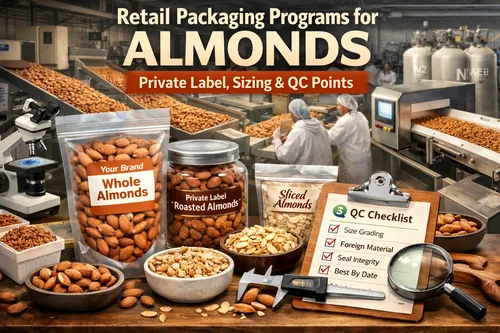
Industrial guide for private label retail almond programs: how sizing impacts cost and appearance, which formats fit snack vs bakery channels, what packaging choices protect shelf life, and the QC checkpoints that reduce complaints and rework.
Previous: Oxidation and Rancidity Control in Almond Ingredients: Storage and Packaging • Next: In-Shell Almonds (Natural): Sorting, Moisture, and Export Considerations
Related: bulk almond products • products catalog • request a quote
Why private label almond packaging projects stall
Most delays aren’t about almond availability—they’re about alignment. A private label program usually fails from small mismatches: the wrong sizing for the target price point, unclear defect limits, packaging that can’t hold the shelf-life promise, or label approvals that happen too late.
Buyer goal: lock the “program triangle” early—(1) format + sizing, (2) packaging + shelf life, (3) QC + documentation. If one side is vague, you’ll pay for it in rework and back-and-forth.
Where this format fits in production
Retail packs sit between bulk procurement and consumer expectations. Start with the end use: snack, baking, trail mix, culinary, or multi-use pantry staple. Then work backward to the almond format that delivers the right eating experience and the least processing complexity.
- Snack programs: emphasize whole-kernel appearance, uniformity, and freshness.
- Bakery programs: emphasize cut consistency and flow on the line (slices/slivers/dice).
- Multi-use retail SKUs: balance appearance and value; demand stronger packaging control due to longer dwell times.
Almond sizing basics (what buyers actually mean)
For whole almonds, “sizing” commonly means count-per-ounce (how many kernels are in one ounce). Lower counts mean bigger almonds; higher counts mean smaller almonds.
- Why it matters: sizing drives pack appearance, consumer perception, and cost.
- Why it causes disputes: buyers request “large” almonds without specifying a range, then reject lots that look smaller.
- How to avoid it: specify a count range (or a recognized size designation) and define the acceptable variance.
Practical tip: if you’re competing on price, pick a sizing that still looks good in the consumer pack (especially for clear windows or high-visibility pouches).
Format options private label programs use
Retail almond programs typically start with one “hero” format, then expand to additional SKUs once sizing, packaging, and QC are stable.
Whole-kernel retail formats
- Natural (skin-on) whole almonds: common for snack and pantry staples.
- Roasted whole almonds: require roast profile alignment, oil/seasoning management, and tighter oxidation controls.
- Blanched whole almonds: used for premium appearance and certain culinary applications; blanch quality matters.
Bakery and ingredient cuts
- Sliced: visible topping; consistency matters for appearance on baked goods.
- Slivered: narrower cut; used in confectionery and bakery.
- Diced / chopped: baking and inclusions; more forgiving visually but higher FM and dust control needs.
- Meal / flour: specialty; requires different flow/moisture handling and packaging controls.
Packaging options for retail almond programs
Packaging is a shelf-life decision. Almonds are sensitive to oxidation; oxygen exposure, heat, and light accelerate off-flavors, especially in roasted and seasoned SKUs.
Common retail pack styles
- Stand-up pouches (SUP): strong shelf presence; often paired with reseal features.
- Pillow bags: cost-efficient; best for faster-turning value SKUs.
- Rigid canisters/jars: premium perception; strong protection during handling.
- Club packs: larger sizes; emphasize fill consistency and pallet-friendly case packs.
Barrier and oxygen control (high-level)
If the program targets longer shelf life or slower retail turns, prioritize higher barrier packaging and careful filling practices that reduce oxygen exposure. Roasted formats generally need more protection than raw.
Fast rule: Longer shelf-life target → stronger barrier and tighter seal integrity expectations. If you want to optimize cost, do it only after the program is stable and complaint rates are low.
Private label workflow: approvals that drive lead time
Packaging programs often slip due to artwork, proofing, and change control. Build this workflow into your launch plan.
- SKU definition: pack size, format, sizing, seasoning (if any), shelf-life target.
- Label content lock: allergens, storage instructions, country of origin expectations, barcode placement.
- Artwork + dielines: film/label specs, regulatory review, retailer requirements (if applicable).
- Packaging procurement: film/labels lead time, MOQs, changeover constraints.
- First production run: validate weights, seals, date coding, and finished pack appearance.
Common delay: “small” label changes after film is ordered. Avoid by setting a hard freeze date for label content.
QC points that matter most in packaged almonds
Retail QC isn’t only “pass/fail COA.” It’s about reducing consumer complaints: stale flavor, inconsistent sizing, excessive chips/dust, foreign material, or a roast that doesn’t match expectations.
Raw material QC (before packing)
- Sizing consistency: define acceptable range and how it’s verified.
- Defect limits: chips, splits, doubles, insect damage, discoloration—set limits aligned to SKU positioning.
- Foreign material controls: specify critical limits and inspection method expectations.
- Moisture targets: align to texture expectations and storage safety.
- Micro requirements: match your category risk posture and customer requirements.
In-process QC (during packing)
- Checkweighing: control net weight variance and define rework rules.
- Seal integrity: define seal checks and sampling frequency; confirm seals survive distribution handling.
- Metal detection / X-ray: if used, document verification cadence and sensitivity targets.
- Date coding: ensure lot/date coding supports traceability and recall readiness.
Finished goods QC (after packing)
- Sensory checks: smell/taste for freshness; retain reference samples per lot for investigations.
- Pack appearance: settle/dust level should match consumer expectations for the SKU.
- Case/pallet integrity: protect packs from crushing and heat exposure in transit.
Complaint reduction tip: define a written “stale/rancid” workflow: retain samples, connect each complaint to lot + packaging + storage history, and set clear corrective actions.
Shelf-life planning: match the label to reality
Shelf life is affected by packaging barrier, oxygen exposure during filling, storage temperature, and time in distribution. If your SKU will sit longer in the channel, build a more conservative program (stronger packaging and tighter inventory discipline).
- Storage expectations: confirm warehouse temperature/humidity targets.
- Transit time: long routes add both time and temperature exposure risk.
- Rotation rules: define FIFO/FEFO expectations in distribution.
Spec checklist to send when requesting a private label quote
To reduce back-and-forth, lock these items early:
- Product: whole or cut, natural/blanched/roasted, seasoning (if any).
- Sizing: count-per-ounce range (whole) or cut dimensions/distribution (sliced/slivered/diced).
- Quality: defect limits, appearance expectations, foreign material controls.
- Moisture + storage: targets and receiving method; storage expectations.
- Micro: category requirements and documentation needs.
- Packaging: pack style, net weight(s), barrier expectations, reseal features (if any).
- Label: artwork owner, approval steps, change control rules.
- Logistics: case pack, pallet configuration, destination, timeline.
- Volume: first run size, annual forecast, seasonality.
How to request a quote with fewer back-and-forths
Send: product + format, sizing definition, defect limits, moisture target, packaging format + net weight, shelf-life target, initial volume, annual forecast, destination, and timeline. If you have an existing spec sheet or packaging requirements, attach them.
Next step
If you share your retail SKU goals (pack size, channel, shelf-life target) and your preferred almond format + sizing, we can confirm packaging options, QC checkpoints, and the fastest supply lane. Use Request a Quote or email contact@atlastradehouse.com.