
Storage and Warehousing for Almonds: Temperature, Humidity, and Oxidation
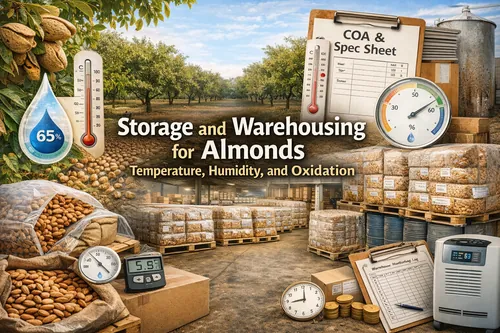
Industrial buyer guide to bulk almond storage and warehousing. Learn how temperature, humidity, and oxygen exposure drive oxidation and shelf-life performance, plus what buyers can control through packaging, receiving, and warehouse discipline. Includes a procurement-ready checklist for specs, COA expectations, monitoring, and logistics planning.
Previous: Sorting, Sizing, and Defect Removal: How Almond Grades Are Built • Next: Traceability and Crop-Year Planning for Almond Buyers: Forecasting and Programs
Related: bulk almond products • products catalog • request a quote
Why storage and warehousing details matter to almond buyers
For many industrial programs, almond quality is won or lost after the product has already been processed. Even clean, well-graded almonds can drift in flavor and performance if warehousing is too warm, too humid, or poorly managed after opening. Storage is not just a “warehouse problem”—it is a procurement risk driver.
What buyers feel when storage goes wrong
- Off-odor/off-flavor complaints: “stale,” “painty,” or “rancid” notes that show up in finished products.
- Shorter-than-expected shelf life: lots that seem fine at receiving but degrade earlier in the production cycle.
- Inconsistent color/appearance: especially in sensitive inclusions and premium snack mixes.
- Receiving disputes: COA says product meets spec, but sensory acceptance fails due to handling history.
- Higher waste and rework: segregating lots, re-testing, blending, or downgrading applications.
Procurement framing: Storage controls are a form of insurance. If your almonds sit in inventory, travel long distances, or go into flavor-sensitive products, storage discipline is one of the highest-leverage ways to reduce risk.
Oxidation and rancidity: the simple model buyers can use
Almonds are a high-fat ingredient. That is good for texture and nutrition—but it also means almonds are naturally vulnerable to oxidation. Oxidation is a chemical process that slowly changes fats over time, and the sensory result is what most teams call “rancidity.”
The four main drivers of oxidation in real supply chains
- Heat: warmer storage and hot transit accelerate oxidation and shorten shelf-life stability.
- Oxygen exposure: opening packaging and leaving product unsealed increases the oxygen available to react with fats.
- Time: longer holding periods increase the importance of cooler storage and tight handling controls.
- Damage/defects: broken kernels, high defect rates, or stressed lots often oxidize faster than clean, uniform product.
Why “it tasted fine last week” happens
Oxidation often presents as a gradual drift, not a sudden failure. A lot can pass receiving and still become problematic later if it is repeatedly opened, exposed to warm air, or stored in fluctuating conditions. This is why retaining samples and tracking lot usage by date is valuable for industrial programs.
If your finished product is heavily flavored, oxidation drift may be harder to detect early—but it can still impact shelf-life and customer perception over time.
Temperature control: the biggest lever for shelf-life stability
Temperature is often the most influential variable because it impacts the speed of oxidation and the likelihood of quality drift during extended storage. The goal is not “perfect cold chain” for every use case. The goal is to match temperature control to your shelf-life target, inventory turns, and risk posture.
How to decide whether you need cooler storage
Cooler storage (including refrigerated or otherwise temperature-controlled warehousing) tends to be most valuable when any of the following are true:
- Long inventory turns: you hold product for months rather than weeks.
- Flavor-sensitive products: confections, premium snacks, clean-label dairy alternatives, mild bakery bases.
- Warm climates or seasonal heat: higher ambient temperatures raise baseline risk.
- Export or long transit lanes: long shipping duration increases exposure time.
- High-value SKUs: the cost of a complaint or recall dwarfs the cost of improved storage control.
Temperature swings: an under-discussed risk
Fluctuations can be as damaging as high average temperature, especially if they create condensation risk in warehouses or trailers. Operationally, swings also increase the chance that different pallets in the same lot experience different histories, which can create “mystery variability” in production runs.
Buyer actions that help
- Communicate shelf-life expectations and typical inventory turns when qualifying a supplier lane.
- Align storage recommendations between supplier and your warehouse/plant (what “cool and dry” means in practice).
- For high-sensitivity programs, request temperature-control expectations for storage and shipping where feasible.
Humidity and moisture: stability, mold risk, and “hidden” quality drift
Almonds are a low-moisture food, which generally reduces microbial growth risk. However, moisture still matters for two reasons: (1) moisture can influence texture and shelf-life stability, and (2) moisture events (humidity spikes, condensation, water intrusion) can create localized quality problems.
Where humidity causes practical problems
- Condensation events: when warm, humid air contacts cooler surfaces (or product), water can condense and create a localized risk pocket.
- Packaging compromise: punctures, torn liners, or broken seals allow humidity and odors to interact with product.
- Warehouse moisture sources: wet floors, leaks, poor dock seals, or product stored near doors in rainy seasons.
- Texture drift: some buyers notice texture differences when product experiences moisture changes over time.
Moisture target vs moisture history
Many teams focus on the moisture number on the COA, which is important. But in warehousing, the bigger issue can be the moisture history: did pallets sit on a humid dock, were liners repeatedly opened and left unsealed, did product travel through weather exposure? This is why packaging integrity and handling discipline often matter as much as the COA value.
Buyer framing: Moisture problems in almonds are often event-driven (a leak, a bad dock, a torn liner), not “the whole lot is wet.” Receiving checks and warehouse discipline catch the event before it becomes a complaint.
Oxygen exposure and handling after opening: where many programs lose shelf life
In bulk operations, the most common oxygen mistake is simple: a pallet is opened for partial use, then left loosely closed or repeatedly opened without resealing discipline. Every opening introduces new oxygen, and warm warehouse air amplifies the oxidation driver.
Common real-world failure modes
- Partial bags left unsealed: even “folded over” liners leak air over time.
- Multiple access points: teams pull product from different cases on the same pallet, increasing exposure surface area.
- Extended staging: product sits in production staging areas for days instead of being returned to controlled storage.
- Repacking without controls: product transferred to bins or totes without defined covers, labeling, and time limits.
Simple handling rules that preserve quality
- Open only what you will use: choose packaging sizes aligned with consumption rate when possible.
- Reseal immediately: treat resealing like a critical control for quality, not a “nice to have.”
- Minimize warm exposure time: keep product in controlled storage until needed.
- Keep lots isolated: avoid mixing partials from different lot codes unless you intentionally blend and document it.
Packaging options for bulk almonds: what matters for warehousing outcomes
Packaging is the interface between your almonds and the warehouse environment. For most bulk programs, packaging needs to do three things well: protect from moisture events, limit oxygen exposure, and survive handling without punctures or seal failures.
Packaging features buyers typically evaluate
- Liner quality and seal integrity: strong liners reduce moisture and odor exposure and help preserve aroma over time.
- Puncture resistance: reduces risk during pallet moves and warehouse handling.
- Labeling and lot coding visibility: supports traceability and clean FIFO/FEFO execution.
- Case/bag configuration: affects how often the product is opened and how easy it is to reseal.
- Pallet stability: reduces damage and helps maintain consistent storage conditions across the load.
How to match packaging to your use case
If you have fast inventory turns, standard bulk packaging may be sufficient. If you have long holding periods, warm conditions, or export lanes, consider aligning on packaging that supports longer protection and better resealing discipline. Buyers often overlook that packaging is an operational tool: it can reduce labor and shrink by preventing damage and rework.
Packaging availability and configuration can vary by supplier program and destination. Share constraints early (dock height, pallet pattern, re-pack needs, container loading requirements).
Warehouse practices that protect bulk almonds (buyer-ready playbook)
Warehousing outcomes improve most when there is a simple playbook that receiving, QA, and production all follow. These practices reduce variability, protect shelf life, and make supplier performance easier to evaluate.
1) Storage location strategy
- Avoid doors and docks: these zones see the biggest temperature/humidity swings.
- Keep off floors: pallets reduce moisture exposure and help with sanitation.
- Segregate allergens: almonds are a tree nut allergen; store with appropriate identification and controls.
- Keep lots intact: limit “partial pallet scattering” that increases exposure and traceability confusion.
2) Inventory rotation: FIFO vs FEFO
Many teams run FIFO (first in, first out). For shelf-life-sensitive programs, FEFO (first expire, first out) can be more protective if you have reliable date coding and internal tracking. The most important point is consistency: choose a method and execute it by lot code.
3) Opening and resealing discipline
- Define who can open pallets and how partials are closed.
- Use a standard label for partial pallets (lot code, opened date, responsible line/department).
- Set a maximum “staging time” outside controlled storage.
4) Retains and complaint readiness
Retains are a low-cost tool that pays for itself the first time you get a quality question. Keep a retained sample by lot code and store it in a controlled location. If a complaint happens, you can compare: receiving retain vs in-process product vs finished product. That comparison often reveals whether the issue is supplier-related or handling-related.
Practical quality leadership: If you want consistent almonds, you need consistent behaviors. The best storage program is the one your team can execute every day.
Shipping and transit risks: protecting almonds beyond the warehouse
Even if storage is strong, transit can create exposure. Bulk almonds may travel in regional truck lanes or long-distance shipments. In warm seasons and long routes, transit history becomes a meaningful part of the quality story.
Common transit risk drivers
- Hot trailers and yard dwell time: product waiting in a trailer can see higher temperatures than expected.
- Multiple stops: repeated door openings introduce warm, humid air.
- Delays: longer transit increases exposure time to heat and oxygen.
- Poor pallet protection: damaged stretch wrap and unstable loads increase puncture and seal-failure risk.
Buyer actions that reduce transit risk
- Communicate seasonal risk periods and plan inventory to avoid emergency freight during peak heat.
- Confirm pallet protection expectations and labeling/lot coding readability on arrival.
- If your program is high-sensitivity, align with your supplier on storage and shipping recommendations appropriate for your lane.
Monitoring plan: how to make storage quality measurable
Buyers often ask, “How do we know storage is working?” The answer is to make it measurable in a way that fits your operation. You don’t need lab-heavy testing for every program, but you do need a repeatable routine that catches drift early.
Simple monitoring elements industrial teams use
- Warehouse condition logging: record general temperature/humidity trends where almonds are stored (especially in warm seasons).
- Receiving sensory checks: consistent odor checks at receipt and before long-hold usage.
- Retain reviews: periodically compare stored retains against a reference lot for flavor drift.
- Nonconformance patterns: track issues by lot code and storage location to identify systemic causes.
What to do when you see drift
When a lot begins to drift, the smartest move is often to act early: reassign the lot to a more robust application, accelerate usage, or isolate it for further evaluation. The goal is to prevent a borderline lot from reaching a high-sensitivity SKU and becoming a customer complaint.
Procurement checklist: specs and COA fields that support storage success
Storage outcomes start with buying the right product and defining acceptance criteria that match your risk profile. Below are procurement-facing checkpoints that help QA and operations execute consistent bulk almond programs.
Core spec items to define (buyer-friendly)
- Format: natural kernels, blanched, roasted, sliced/slivered/diced, meal/flour, paste/butter (as applicable).
- Grade and appearance expectations: what “acceptable” looks like for your SKU and customer expectations.
- Moisture target: a key driver of stability and shelf-life performance.
- Defect limits: insect damage, chips/broken, foreign material categories (as required by your program).
- Sensory acceptance: clean, fresh almond aroma; no stale, musty, or rancid notes at receipt.
- Packaging requirements: liner/seal expectations, pallet configuration, labeling and lot code placement.
- Storage recommendations: documented expectations for how product should be stored and handled after opening.
COA items buyers commonly request
COA content varies by supplier program. For storage-focused quality management, the most useful COA is one that clearly ties to the shipped lot code and includes the fields your receiving team actually uses to accept product.
- Lot code identification: must match packaging labels and shipment documents.
- Moisture: key parameter tied to stability and warehouse expectations.
- Program-specific quality fields: defect summaries where provided and relevant to your spec.
- Traceability identifiers: production/shipment identifiers that support internal tracking.
Procurement reality: If you want predictable storage outcomes, buy predictable lots. Clear specs + consistent COA fields reduce receiving disputes and help separate supplier issues from handling issues.
Receiving checklist: what to inspect for storage and shelf-life risk
Receiving is where you catch the issues that can quietly become shelf-life problems later. A quick, consistent receiving routine prevents months of downstream drift.
Receiving inspection checklist (bulk almonds)
- Packaging integrity: no punctures, water damage, broken seals, or compromised liners.
- Lot code capture: record lot codes and connect them to COA and internal inventory records.
- Odor check: clean almond aroma; reject or hold if rancid, musty, or chemical notes are present.
- Visual check: foreign material signals, excessive broken product (if whole-kernel program), unusual discoloration.
- Storage placement: move promptly into appropriate storage (avoid long dock dwell time).
- Retains: collect and label retained samples by lot for tracking and investigation support.
If you operate FEFO or have strict shelf-life commitments, add a step to record “opened date” for partial pallets and define a resealing standard.
Questions to ask suppliers to improve storage outcomes
Storage performance is a shared responsibility. The supplier controls processing, initial packaging, and release criteria. The buyer controls receiving, warehousing, and handling after opening. These questions help align both sides early:
Storage and shelf-life questions
- What storage conditions do you recommend for this format? Ask for practical guidance for warehouses and production staging.
- How should partial bags/cases be resealed? Ask for recommended practices that preserve sensory performance.
- What packaging options are available? Align liner and seal expectations to your inventory turns and risk.
- What is the typical shelf-life posture for this program? Focus on your use case and planned holding time.
Traceability and documentation questions
- Can you provide a sample COA? Confirm moisture field and lot code linkage.
- How are lot codes applied and where do they appear? Packaging labels, cases, pallet labels, and documents.
- What documentation is available? COA, allergen statement, country of origin, and program-dependent compliance documents.
Quality stability questions
- What defect ranges are typical for this grade? Helps you set realistic specs and plan buffers.
- How do you manage foreign material controls? Screening, sorting, magnets/metal control (program dependent).
- What changes might affect lot consistency? Packaging changes, crop-year transitions, or format changes.
FAQ: storage and warehousing for bulk almonds
What causes almonds to go rancid in storage?
Rancidity is mainly driven by oxidation. Heat, oxygen exposure, time, and kernel damage accelerate oxidation and can create stale or painty off-notes. In many facilities, the biggest driver is handling after opening: partial liners not resealed and pallets staged in warm areas too long.
Do almonds absorb moisture from humid air?
Almonds can take on moisture depending on storage conditions and packaging integrity. High humidity and temperature swings can increase condensation risk. Buyers typically manage this through intact liners, quick dock-to-storage movement, and consistent resealing practices.
Is refrigerated storage necessary for bulk almonds?
Not always, but cooler storage generally improves shelf-life stability. The decision depends on shelf-life targets, inventory turns, climate, and how flavor-sensitive your finished product is. High-sensitivity programs often choose cooler storage and tighter handling discipline.
What should a buyer check at receiving to protect shelf life?
Confirm packaging and liner integrity, capture lot codes, verify COA linkage, perform an odor check, and store pallets promptly in appropriate conditions. Keeping retained samples by lot helps track drift and supports faster investigations.
How does packaging affect almond shelf life?
Packaging affects oxygen exposure and moisture ingress risk. Strong liners, good seals, puncture resistance, and disciplined resealing practices reduce oxidation drivers and help maintain consistent flavor over time, especially when product is held in inventory.
Next step
If you share your application, storage conditions, and expected inventory turns, we can recommend practical spec checkpoints, packaging options, and a supply lane that matches your shelf-life and quality targets. Use Request a Quote or email contact@atlastradehouse.com.
For sourcing, visit bulk almond products or browse the full products catalog.