
Using Almond Flour in Commercial Baking: Texture, Moisture, and Yield
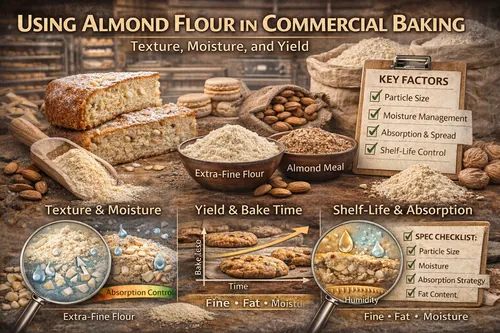
Industrial guide to using almond flour in commercial baking: texture engineering, moisture management, and yield consistency. Covers almond flour vs meal selection, particle size effects on batter viscosity and crumb, absorption strategy, processing and shelf-life notes, packaging and receiving guidance, QA/spec sheet checkpoints, troubleshooting, and a buyer-ready RFQ template for bulk almond flour programs.
Next: Almond Meal vs Extra-Fine Almond Flour: Selecting the Right Grind for Production
Related: bulk almond products • products catalog • request a quote
Quick takeaways for commercial bakeries:
1) Almond flour behaves like a high-fat, fine particle ingredient—particle size and fat content strongly influence viscosity and spread.
2) “More moisture” isn’t always better: you need controlled water activity and predictable bake loss to protect shelf life and texture.
3) Yield drift is often caused by incoming moisture variation + absorption differences + deposit weight sensitivity.
4) The fastest way to stabilize results is to align a measurable spec sheet (mesh/PSD, moisture, fat) with your receiving tests and line settings.
Where this format fits in production
Almond flour is used in commercial baking for three main reasons: texture differentiation (tenderness, richness, mouthfeel), formulation flexibility (gluten-free or reduced wheat systems), and performance benefits (moisture retention and perceived freshness). In industrial settings, it is also used to create premium positioning—especially in cakes, cookies, bars, and pastry components where “real almond” identity matters.
Typical industrial use cases
- Cakes and muffins: richer crumb, moisture retention, and flavor lift.
- Cookies: flavor, chew and tenderness; in some designs, controlled spread and browning.
- Bars: structure and binding in high-solid systems (often paired with syrups).
- Macaron-style products: fine grind for smooth shells and consistent rise.
- Fillings and frangipane-style bases: body, flavor, and fat functionality.
- Gluten-free / reduced-grain SKUs: bulk and structure where wheat flour isn’t the primary base.
The operational benefit is that almond flour can replace some internal processing steps (grinding/sieving) and make scaling easier—if you lock down the spec.
What “almond flour” means in industrial baking
In the market, “almond flour” and “almond meal” are sometimes used interchangeably, but in commercial baking you should treat them as different families unless proven otherwise. The key practical distinction is usually particle size distribution (how fine it is and how tightly the distribution is controlled), and whether the product is blanched (skin removed) or natural (skin-on).
Blanched vs. natural almond flour
- Blanched: lighter color, smoother crumb, preferred for light cakes, macarons, and products where specks are undesirable.
- Natural (skin-on): more flecked appearance and slightly different flavor perception; can read as “whole food” in rustic SKUs.
Defatted vs. full-fat (program-dependent)
Many bakery programs use full-fat almond flour. Some applications use partially defatted almond ingredients to change absorption, reduce oiling-out, or manage cost. If fat content matters in your formulation, make sure it’s explicitly included in the spec and on the COA.
Particle size: the hidden driver of texture and handling
Particle size distribution affects how almond flour behaves in mixing and baking. It changes surface area (which changes water binding), and it changes perceived texture (fine = smoother crumb; coarse = more grain). Two flours can have the same “mesh” label and still perform differently if their distribution shape or fines fraction differs.
Why finer almond flour often behaves differently
- Smoother crumb: fewer large particles means fewer “grainy” cues in cakes and delicate items.
- Different batter viscosity: high surface area can bind water quickly, increasing viscosity and changing aeration.
- Reduced visual specking: especially for blanched extra-fine products.
- Process sensitivity: fine flours can create dusting, bridging, or clumping if receiving and handling are not optimized.
Why coarser almond meal can be useful
- Rustic texture: intentional bite in bars and cookies.
- Less dust: often easier to handle in some bulk systems.
- Different water dynamics: may absorb more slowly and change mixing time sensitivity.
Procurement translation: Don’t buy “almond flour” by name alone. Buy it by mesh/PSD targets and a defined fines limit—then validate it in your highest-sensitivity product (often cookies or macarons).
Moisture management: absorption, water activity, and bake loss
In commercial baking, “moisture” is not a single variable. You manage (1) water added, (2) water bound, (3) water lost in baking, and (4) water activity (aw) that drives shelf-life behavior. Almond flour affects all four because it contributes solids, fat, and a fine particle network that changes how water is held and released.
Absorption and hydration behavior
Almond flour can increase or change water demand depending on particle size, fat content, and how it’s processed. Fine flours typically hydrate quickly and can thicken batters early. If you add all water at once, you may see batch-to-batch viscosity swings.
Water activity (aw) and shelf stability
Two products can have the same moisture content but different aw—and aw is often the more useful predictor of microbial stability and texture drift. If you are designing for longer shelf life, treat aw as a design target and validate how almond flour impacts your system.
Bake loss and moisture retention
Almond flour can change bake loss and perceived freshness. A richer, tender crumb is often interpreted as “moister,” even when total moisture is not dramatically higher. For yield control, what matters is consistency: stable bake loss means stable finished weights.
Note: Always align moisture/aw targets with your internal food safety program and product category requirements.
Yield consistency: why weights drift (and how to stabilize them)
“Yield” in commercial baking usually means a combination of: deposit accuracy, bake loss, finished weight compliance, and rework rate. Almond flour can influence each component. The most common root causes of yield drift are:
- Incoming moisture variation: changes solids basis and water needs.
- Particle size variation: changes hydration rate and batter viscosity, which affects depositor performance.
- Fat content variation: changes lubrication, spread, and perceived tenderness.
- Mixing energy differences: can change aeration and density; density changes change weight/volume relationships.
- Staging time: batters and doughs often change viscosity during hold—especially with fine almond flour.
Controls that stabilize yield
- Standardize incoming specs: moisture + particle distribution + (if relevant) fat content.
- Set a viscosity (or density) target at deposit: define a window and adjust water addition to hit it.
- Control staging time: set maximum hold time and re-mix strategy.
- Document adjustments: use a controlled “water correction” SOP instead of ad-hoc operator tweaks.
High-impact KPI: If you only track one number to catch drift early, track batter/dough temperature and a simple deposit viscosity proxy (flow time or equipment load). Those two usually explain most yield surprises.
Application notes: how almond flour shifts texture by product type
Cakes and muffins
Almond flour often increases perceived richness and tenderness. Fine flour supports smoother crumb; coarser meal can create a slightly grainy bite. Watch batter viscosity and aeration: if the batter thickens quickly, you can lose volume and get dense crumb. If the batter is too thin, you can see segregation and uneven crumb.
Cookies
Cookies are a “sensitivity test” for almond flour variability because spread and texture respond strongly to changes in fat availability, particle size, and hydration. If cookie spread is drifting, lock down flour specs first, then validate mixing time, dough temperature, and rest time.
Bars and high-solid systems
In bars, almond flour can add body and reduce crumbling, but it can also increase density if hydration isn’t balanced. Pay attention to fines: too many fines can make bars pasty or heavy, while too coarse can lead to crumbly texture.
Macaron-style products and delicate shells
These products often require a controlled fine grind for smooth shells and consistent rise. Variability in particle size can show up as rough surfaces, inconsistent feet, or fragile structure.
Fillings and frangipane-style bases
Almond flour provides structure and flavor, but the fat content and hydration behavior can change set and sliceability. If you see oiling-out or soft set, review fat phase and solids structure; if you see dryness, review hydration and bake profile.
Process controls: mixing, staging, depositing, and sanitation
Almond flour is a fine particulate ingredient; commercial plants should manage it like other fine powders: control dust, prevent bridging, and standardize addition and mixing energy.
Mixing strategy
- Addition order: decide whether almond flour is added with other dry ingredients or as a separate step to manage hydration.
- Mixing energy: over-mixing can change aeration and density; under-mixing can create lumps and uneven hydration.
- Temperature control: warmer systems often flow more but may increase spread and accelerate oxidation of nut lipids.
Staging and depositing
- Hold time limits: batters can thicken during hold; set max time and re-mix SOP.
- Depositor settings: viscosity and density drift require controlled correction steps.
- Screening: if lumps are an issue, evaluate screening or pre-blending—but confirm it doesn’t remove functional fractions.
Sanitation and allergen controls
Almond flour is a tree nut ingredient. Align storage, handling, and sanitation with your allergen management program, including line changeover procedures and verification steps.
Shelf-life and oxidation considerations
Almond ingredients contain unsaturated fats and can be sensitive to oxidation, especially with heat exposure and oxygen. In bakery products, oxidation can present as flavor flattening or off-notes over time. Packaging barrier properties, storage temperature stability, and minimizing unnecessary warm holds help protect sensory quality.
Practical shelf-life validation
- Sensory checkpoints: day 0 vs. mid-life vs. end-of-life flavor confirmation.
- Temperature stress tests: simulate realistic distribution to catch oxidation and texture drift early.
- Package interaction: verify whether packaging accelerates aroma loss or oil pickup effects.
Packaging options for bulk almond flour programs
Bulk almond flour is commonly shipped in sealed bags with liners, cartons, or other industrial formats depending on the program. The goal is to protect against moisture pickup and oxidation while fitting your receiving and storage constraints.
Common formats
- Multiwall bags with food-grade liners: common for flour/meal; confirm net weight and pallet configuration.
- Lined cartons: strong stackability and lot control; often used for controlled specialty grinds.
- Bulk systems (program-dependent): for high volume users—confirm dust control and handling requirements.
Receiving notes
- Keep sealed until use: reduce moisture pickup and aroma loss.
- Stage appropriately: avoid warm staging and direct sunlight.
- Lot traceability: ensure labeling remains legible through internal processes.
Format and spec checkpoints buyers should confirm
In commercial baking, the best spec sheet is the one that matches what you actually control and test at receiving. Below is a practical checklist for bulk almond flour procurement.
Core spec items
- Type: almond flour vs meal; blanched vs natural.
- Particle size/mesh distribution: define method and acceptance range; include fines limits if critical.
- Moisture: target range and method.
- Fat and protein (as needed): especially if you tune spread, tenderness, or labeling requirements.
- Color/sensory: define acceptance and off-note rejection criteria.
- Micro requirements: define by category and internal food safety program.
- Foreign material controls: defect tolerance and expectations for FM prevention.
Documentation commonly requested
- COA: lot-level certificate aligned to your spec.
- Spec sheet: agreed targets and methods.
- Allergen statement: tree nut declaration and cross-contact statement as required.
- Country of origin: statement and supporting documents if needed for your market.
Buyer note: If you see drift in texture or yield, ask for the supplier’s mesh/PSD report and compare it across lots. PSD drift is one of the most common hidden causes of baking variability.
Troubleshooting guide: common defects and likely causes
| Problem | Likely drivers | First checks |
|---|---|---|
| Dense crumb / low volume | Batter too viscous, rapid hydration, mixing/aeration changes | Particle size, water addition strategy, batter temperature |
| Cookie spread drift | Fat content variation, PSD variation, dough temp/rest changes | COA fat/moisture, mesh/PSD report, dough temperature |
| Gritty texture | Too coarse grind, wide distribution, lumps from poor dispersion | Mesh/PSD, mixing order, screening evaluation |
| Dry mouthfeel | Under-hydration, high bake loss, formula imbalance | Bake loss, water correction SOP, storage conditions |
| Rancid/off notes over time | Oxidation, warm holds, oxygen exposure | Packaging, storage temperature, retained sample sensory |
If you want faster root cause analysis, retain a sample of each lot and record: incoming moisture, PSD/mesh info, and batter/dough temperature at deposit. Those three often explain most drift.
How to request a quote with fewer back-and-forths
Quotes are fastest when suppliers know your grind requirements, packaging, and documentation needs up front. Use this template for bulk almond flour sourcing.
RFQ template (copy/paste):
Product: Almond flour for commercial baking
Type: blanched / natural • flour vs meal (target grind: standard / fine / extra-fine)
Particle size/mesh: [method + targets] • fines max % (if critical): [ ]
Moisture target/range: [ ]
Fat/protein targets (if required): [ ]
Micro requirements: [targets appropriate for your category]
Packaging: bags/cartons + liners • net weight per unit: [ ] • pallet config: [ ]
First order volume: [lbs/kg] • Annual forecast: [lbs/kg]
Destination: [city, state/country] • Incoterms (if applicable): [ ]
Timeline: sample by [date], first production by [date]
Documentation needed: COA, spec sheet, allergen statement, country of origin, other: [ ]
Notes: application (cake/cookie/bar/macarons), deposit method, storage constraints: [ ]
FAQ
Does almond flour always increase moisture?
Almond flour often increases perceived moistness because it contributes fat and tenderness, but finished moisture depends on the full formula and bake profile. For predictable outcomes, manage absorption and bake loss rather than assuming almond flour automatically “adds moisture.”
What’s the fastest way to stabilize texture when switching suppliers?
Align on measurable specs (moisture + particle distribution + fat if relevant), then run a controlled trial in your most sensitive product. Document any water correction strategy and keep deposit temperature consistent.
Should we test particle size at receiving?
If your products are sensitive (cookies, macarons, delicate cakes), yes—at least periodically. Many plants use supplier mesh/PSD documentation plus a simple internal screen check or “feel” validation as a practical control plan.
Next step
If you share your application (cookies, cakes, bars, macarons), target texture, and current pain points (spread drift, density, yield), we can help confirm common almond flour specs (mesh/PSD + moisture + fat), packaging options, and the fastest supply lane. Use Request a Quote or email contact@atlastradehouse.com.
Looking for more almond formats? See bulk almond products or browse the products catalog.