
Walnuts • Milled format • Specs-first sourcing

Bulk Walnut Meal

Atlas Nut Supply, LLC supplies bulk walnut meal (ground walnuts) for industrial buyers in bakery, snacks, coatings, and nutrition systems. We cooperate with multiple California supply partners to align your grind/mesh target, moisture, color/defect limits, packaging, and documentation so procurement and QA can qualify supply efficiently.

Walnut meal performance is driven by particle size distribution and oxidation control. Compared with kernels, meal has more exposed surface area—so the right packaging liner, storage conditions, and realistic shelf-life assumptions matter more.

Format
Meal (ground walnuts)
Programs
U.S. + global export
Support
COA • traceability • docs

Request a quote Read applications Back to catalog

Fastest quoting: tell us meal vs flour, mesh/particle target, pack size, monthly volume, and your destination.
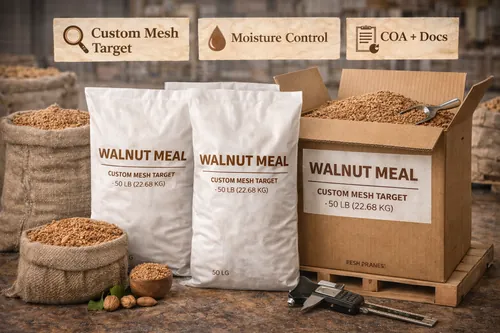
Bulk Walnut Meal for wholesale supply — Atlas Nut Supply

Walnut meal options

Common program variables (availability varies by season and supplier program):

  • Grind targets: meal vs flour-style fine grinds; specify a target to reduce variability.
  • Particle size definition: mesh, micron, PSD range, or “% passing” a specified sieve.
  • Moisture targets: set for flowability (reduced clumping) and storage stability.
  • Color/defect limits: aligned to finished product appearance (especially in light-colored baked goods).
  • Micro requirements: share micro limits or pasteurization expectations if your program needs them.
  • Packaging: bags/cartons with liners; pallet constraints can be aligned to your receiving lane.
  • Documentation: COA and supporting documents available per supplier program.

Need other walnut formats? See Bulk Walnut Products.

Industrial applications & performance notes

Walnut meal is chosen for texture, flavor, and binding. Common uses include:

  • Commercial baking: breads, cookies, brownies, fillings; impacts absorption and crumb texture.
  • Breading/coatings: adds nutty notes and visual texture; spec particle size for consistent coverage.
  • Bars & nutrition blends: supports flavor and bite; manage oil migration and oxidation for shelf-life.
  • Plant-based bases & frozen: used for solids and flavor; finer grinds reduce graininess.

For deeper use-case guidance, see the Academy guide: Walnut Meal for Bakery Systems.

Rule of thumb: if your process is sensitive to mouthfeel, separation, or oil migration, specify a tighter PSD (not just “mesh”).

Quality checkpoints that matter in walnut meal

Walnut meal has more exposed surface area than kernels, so oxidation control and particle-size consistency become more critical. These are the checkpoints buyers most often specify and audit.

Defines mouthfeel, dispersion, and coating performance. Specify a target and acceptable range (or % passing).

Impacts clumping and storage stability. Include your handling, humidity, and storage temperature conditions.

Control oxygen and light exposure with appropriate liners and storage temperature targets.

Align defect tolerance and appearance expectations to the finished product and your QC inspection method.

If your product is sensitive to rancidity, include your shelf-life goal and distribution conditions (ambient vs refrigerated/frozen) in the inquiry.

Product specifications (buyer-facing)

Use the tables below as a quote-ready template. Final limits should match your customer requirements, validation methods, and destination regulations.

1) Core specification fields (typical)

Spec field What buyers typically define Notes
Ingredient statement 100% walnuts (no additives) unless otherwise specified Confirm if “raw” vs “roasted” is required.
Allergens Tree nut (walnut); cross-contact statement per program Include any facility allergen matrix requirements.
Particle size definition Mesh / micron target, PSD range, and/or “% passing” sieve If your process is sensitive, add D10/D50/D90 targets.
Moisture Buyer-defined maximum/target Often set to support flowability and shelf stability (clumping control).
Color / visual Target color band, appearance expectations, specking limits Critical for light baked goods and creams/fillings.
FFA / oxidation markers Optional limits (program-dependent) Often used when rancidity sensitivity is high.
Microbiology Limits and sampling plan; pasteurization requirement (if applicable) Define method + lot release workflow if pathogen testing is required.
Mycotoxins (aflatoxin) Limits by destination/retailer program Common in export lanes and some retail-facing ingredient programs.
Packaging Bag/carton size, liner type, pallet pattern constraints Liner choice can materially affect oxidation outcomes.
Documentation COA, COO/traceability, allergen statement, certifications (if required) State required certificates up front to avoid quote rework.

If you already have a spec sheet, send it. If not, we can turn your requirements into a clean “one-page” spec format for approvals.

2) Example targets (illustrative — align to your program)

Below are example-style targets pulled from typical walnut specifications and marketplace spec formats. Use them as a starting point, then align to your end market.

Parameter Example target Notes
Moisture Max 5.0% (example) Often specified similarly to kernel specs; confirm by application and method.
Free Fatty Acids (FFA) Max 1.0% (example format) Useful for shelf-life sensitive applications; program-dependent.
Microbiology (example format) Salmonella: negative (per defined sample size) Sampling plan and method must be stated (hold-and-release if required).
Aflatoxins (example format) Total / B1 limits as required by destination Limits vary by market; include destination and customer policy for accuracy.

If you require pathogen testing, define the acceptance process (hold-and-release, composite sampling, third-party lab). This is a common audit point in nut programs.

Request a quote with these specs Define mesh / PSD

Mesh & particle size: how to specify walnut meal

“Mesh” alone can still leave wiggle room. The fastest, least-ambiguous way to spec walnut meal is: mesh/micron target + acceptable range and (if needed) a simple PSD statement such as % passing a sieve.

Provide a target in either unit; QA teams often convert between mesh and microns.

Mesh (approx.)Typical opening (microns)Use-case cue
10–20~2000–850 µmCoarse meal / coatings texture
20–40~850–425 µmStandard meal / inclusions
40–80~425–180 µmFine meal / smoother crumb
80–100~180–150 µmFlour-style fine grind

Note: exact openings depend on sieve standard and method. If your QA uses a specific sieve series, reference it in your spec.

  • Target range: “20–40 mesh equivalent” or “425–850 µm.”
  • % passing: e.g., “≥90% passing 20 mesh; ≤10% passing 60 mesh.”
  • D-values (optional): D50 target with D10/D90 bounds for tighter control.
  • Method: sieve stack time, vibration settings, and sample mass.

Tell us your process: mixing speed, hydration, baking/extrusion, and desired mouthfeel. We’ll suggest a practical PSD and an acceptance statement your QA team can work with.

Request a quote Storage guidance

Storage & shelf-life planning (walnut meal)

Walnuts are sensitive to oxygen, heat, and light. Because meal has a higher surface area than kernels, storage discipline and packaging liner choices become even more important. For longer holds, many programs shift from ambient assumptions to refrigerated/frozen planning based on shelf-life needs and distribution realities.

  • Cool + dry: reduces oxidation rate and helps preserve flavor.
  • Seal integrity: keep in air-tight packaging; reclose liners promptly after sampling.
  • Odor control: store away from strong odors (nuts can absorb odors).
  • FIFO rotation: reduces aged inventory and flavor variability.
  • Packaging barrier/liner: oxygen and light protection level.
  • Temperature exposure: warehouse and transit temperature range.
  • Moisture control: humidity exposure can drive clumping and quality drift.
  • Post-open handling: sampling frequency and resealing discipline.

Export lanes: include transit time, port, and expected temperature exposure. These often change packaging and safety stock planning.

Specs checklist (quote-ready)

Send your spec sheet if you have one. Otherwise, start here for faster alignment.

  • Product: Walnut meal
  • Grind target: meal vs flour, mesh/micron target (and acceptable range)
  • PSD definition: % passing (preferred) and/or D10/D50/D90 targets if your process is sensitive
  • Moisture target: and any flowability/clumping constraints
  • Color/defects: visual expectations and defect allowance
  • Micro requirements: limits, sampling plan, and/or pasteurization expectations (if applicable)
  • Mycotoxins: aflatoxin limits if required by your destination/customer program
  • Packaging: bag/carton size, liner requirements, pallet constraints
  • Volume: first order + forecast cadence
  • Destination: city/state/country (and port if export)
  • Documentation: COA, allergen statement, traceability/COO, certifications if required

Share your end application (bakery, coatings, nutrition, plant-based) and processing steps (mixing, extrusion, baking) and we’ll suggest practical spec targets.

FAQ: Walnut meal

Walnut meal vs walnut flour: which should I use?

Use meal when you want texture and visible particulates, and flour when you need smoother mouthfeel or tighter dispersion (smoother fillings, fine crumb systems). Most buyers specify a mesh/micron target and acceptable PSD range to ensure consistent performance.

How do I write a particle size spec that QA can enforce?

Add at least two elements: (1) a target (mesh or microns) with an acceptable range, and (2) a % passing statement across one or two sieves. If your process is sensitive, add D10/D50/D90 targets and define the test method.

What specs do you need to quote bulk walnut meal?

At minimum: grind target (meal vs flour), mesh/micron target (and acceptable range), moisture target, color/defect expectations, packaging, volume, destination, and timeline. If you require micro limits, pathogen testing workflow, or pasteurization, include them in your inquiry.

Do you ship walnut meal outside the United States?

Yes. We support export lanes depending on destination, volume, packaging, and documentation requirements. Share the country/port and timeline for planning.

Can you provide COA and traceability documentation?

Yes. Documentation availability varies by supplier program, but commonly includes COA and traceability/COO support. If you require certifications, note them in your inquiry.

How should walnut meal be stored for best shelf-life?

Store cool, dry, and protected from oxygen and light. Because meal has higher surface area than kernels, oxidation control is especially important. Share your storage temperature range and expected hold time and we’ll recommend practical handling targets.