
Dry Roasted vs Oil Roasted Almonds: Flavor, Shelf Life, and Processing Tradeoffs
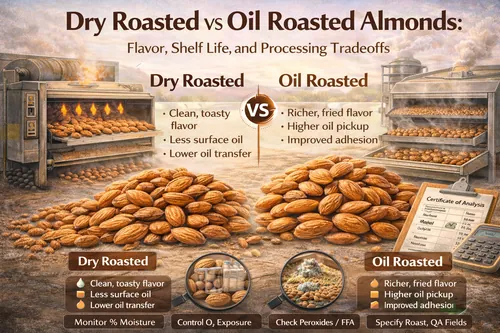
Dry roasting and oil roasting can both create great almond flavor—but they behave differently in production. The method you choose affects seasoning adhesion, perceived richness, handling on inclusion lines, and shelf-life risk. This guide explains practical tradeoffs and how to write a clearer spec for bulk roasted almond programs.
Previous: Pasteurized Almond Kernels for Food Manufacturing: When and Why Buyers Specify It • Next: Sliced Almonds for Bakery & Confectionery Toppings: Sizing and Breakage Control
Related: bulk almond products • products catalog • request a quote
Where each roast method fits in production
Start with the use case (snacks, bakery, confectionery, cereal/granola, dairy alternatives), then pick the roast method that hits flavor and line performance targets with the fewest compensating steps.
- Dry roasted almonds: good for cleaner “toasted almond” flavor, lower surface oil, and easier handling as inclusions (less greasy dusting, fewer oil-migration issues in some systems).
- Oil roasted almonds: good for rounder, richer flavor and improved seasoning adhesion; often preferred in savory snack programs where aroma release and coating performance matter.
Quick buyer shortcut: if you need maximum seasoning stick and “snack aisle” flavor impact, oil roast is often the baseline. If you need cleaner inclusions (bakery/confectionery/cereal) with fewer oil-related headaches, dry roast is often easier to run.
Flavor and texture outcomes
Both methods develop roast notes through heat-driven reactions, but the eating experience can differ:
- Dry roast often delivers a clearer toasted profile and a drier surface feel that reads as “crisp/clean.”
- Oil roast often delivers a fuller, rounder profile with more perceived richness and stronger aroma bloom; surface oil can also increase “savory” impression in seasoned products.
If you are matching an existing benchmark, always specify a roast level target (light/medium/dark or a color reference) plus sensory expectations (sweetness/bitter notes, “clean” vs “fried” character).
Shelf life and oxidation risk: what changes
Roasting can shorten shelf-life if warm product is exposed to oxygen for too long, or if packaging and storage aren’t aligned to your distribution reality. The method changes the risk picture:
- Dry roast risk drivers: heat exposure + oxygen during cooling/holding; over-roasting can add bitter/burn notes that show up early in storage.
- Oil roast risk drivers: added surface oil + roast oil management. If oil turnover/filtration and oil quality control are inconsistent, off-notes can appear earlier and vary more lot-to-lot.
In both cases, the biggest practical levers are fast cooling, fast packing, oxygen control, and cool, stable warehousing.
Processing tradeoffs that matter on real lines
- Seasoning adhesion: oil roast typically improves adhesion and reduces seasoning fall-off; dry roast may require different seasoning systems or process tweaks.
- Inclusion handling: dry roast is often less messy and can reduce clumping or oil transfer into surrounding ingredients in certain mixes.
- Oil migration: oil-roasted pieces can sometimes contribute to greasy appearance or softening in dry mixes if packaging and formulation aren’t designed for it.
- Lot-to-lot consistency: oil roast can vary more if fryer oil management, dwell time, or post-roast draining is not tightly controlled.
Spec checkpoints buyers should confirm (roasted almonds)
A roasted almond spec should be more explicit than a raw kernel spec. Typical checkpoints include:
- Roast method: dry vs oil roasted (and whether seasoning is applied by supplier or by you).
- Roast profile: light/medium/dark, color reference, and sensory targets (avoid “too broad” language like “standard roast”).
- Moisture: confirm target + max; moisture affects crunch and shelf-life performance.
- Oil pickup / surface oil (oil roasted): target range; define acceptable “greasiness” for your equipment and finished product.
- Defects: scorch/burn limits, dark pieces, bitter notes; clarify foreign material controls.
- Micro requirements: align with your category (snacks vs ready-to-eat inclusions vs further-processed products).
- Documentation: COA fields you care about, allergen statement, country of origin; add any program-specific compliance needs.
Packaging options for bulk roasted almond programs
Roasted formats benefit from disciplined packaging because oxidation can accelerate after roasting. Bulk programs commonly use lined bags/cartons; some programs add stronger oxygen/light control depending on shelf-life targets and destination.
- Fast cool + fast pack: reduce warm exposure to air after roast.
- Receiving constraints: share pallet configuration, storage conditions, and any re-pack requirements early.
- Transit reality: match packaging and shelf-life assumptions to your destination and timeline—not just local delivery conditions.
How to request a quote with fewer back-and-forths
Send these fields up front for roasted almond programs:
- Product + format (whole, slivered, sliced, diced) and roast method (dry vs oil).
- Roast profile target (light/medium/dark or reference) + sensory expectations.
- Moisture target + max; defect limits (scorch/dark pieces); micro requirements if applicable.
- Packaging, first order volume, annual forecast, destination, and timeline.
- Required documentation (COA/micro/allergen/country of origin/certifications if applicable).
Next step
If you share your application (snack seasoning, bakery inclusion, confectionery, cereal/granola, etc.) and your desired flavor intensity, we can recommend whether dry roast or oil roast is the better fit—and suggest a practical spec sheet (roast profile, moisture, surface oil, defect limits, packaging) for your buying program. Use Request a Quote or email contact@atlastradehouse.com.