
Pasteurized Almond Kernels for Food Manufacturing: When and Why Buyers Specify It
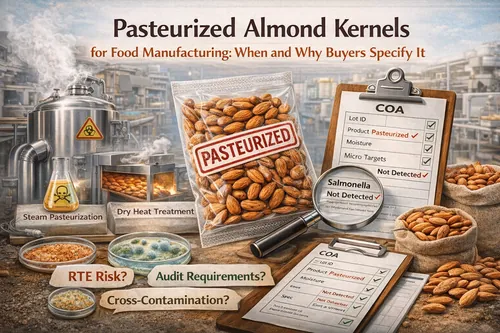
Industrial buyer guide to pasteurized almond kernels: when pasteurization is worth specifying, how it affects your risk posture and documentation, and what to include in your spec, COA checklist, and receiving inspection to prevent rework and complaints. This page is written for food manufacturers sourcing bulk almonds for snacks, bakery, confectionery, dairy alternatives, nutrition, and ingredient systems.
Previous: Almond Meal vs Extra-Fine Almond Flour: Selecting the Right Grind for Production • Next: Dry Roasted vs Oil Roasted Almonds: Flavor, Shelf Life, and Processing Tradeoffs
Related: bulk almond products • products catalog • request a quote
What “pasteurized almond kernels” means in industrial buying
In food manufacturing, “pasteurized almonds” typically means the kernels have received a validated lethality treatment intended to reduce pathogen risk. For buyers, the term is less about the marketing label and more about three practical questions:
- What was treated? Whole kernels, blanched kernels, pieces, meal/flour, or another format.
- How was it treated? The method matters for sensory impact, moisture behavior, and documentation.
- How is it documented? What statements or certificates are available for audits and customer requirements.
Buyer framing: Pasteurization is a way to buy a risk posture. But your finished product safety still depends on your own process flow, post-kill step handling, and how ingredients are stored and staged.
When and why buyers specify pasteurized almond kernels
Buyers specify pasteurized almond kernels when the cost of uncertainty is high: customer requirements, audit posture, ready-to-eat risk, or complicated manufacturing flows where cross-contamination is possible. The goal is not to “over-buy” controls—it’s to apply the right control at the right point in the process.
Common reasons pasteurization becomes a procurement requirement
- Ready-to-eat inclusions: almonds added after the final kill step (or no kill step exists).
- High-sensitivity customers: private label, global brands, and strict QA programs.
- Complex lines: shared equipment, difficult sanitation, or high traffic zones increase risk.
- Low-moisture category discipline: where buyers want strong preventive controls and documentation.
- Recall exposure economics: products with wide distribution or long shelf life where issues are expensive.
When buyers may not need to require it (still confirm internally)
- Validated downstream kill step: your process reliably delivers lethality after almonds are added.
- Non-RTE intermediate use: almonds are later cooked, baked, or processed under controlled conditions.
- Short, controlled supply chain: limited distribution and rapid inventory turns (risk still exists, but exposure is smaller).
RTE vs further-processed: the decision that drives most specs
One of the most common sources of buyer-supplier misalignment is not clarifying whether the almonds are intended for ready-to-eat (RTE) use or further processing. These are different risk postures, and they affect which documents and tests matter most.
Ready-to-eat ingredient posture
- Often requires stronger upstream control and clearer documentation.
- Receiving and staging practices matter more (avoid post-treatment contamination).
- Micro requirements and retain sampling programs are more common.
Further-processed posture
- Downstream lethality may reduce the need for strict upstream requirements.
- Focus may shift toward moisture, defects, sizing, and sensory stability.
- Still requires careful handling to avoid cross-contamination and quality drift.
Practical tip: Put intended use on your RFQ (example: “pasteurized almonds for RTE inclusions” vs “almonds for baked application with validated kill step”). It reduces back-and-forth and prevents wrong-lane supply offers.
Common almond pasteurization / lethality treatment methods (buyer-level overview)
Suppliers use different validated programs, and the exact parameters are typically part of the supplier’s process control. As a buyer, you don’t need the confidential settings—but you do need to know the method category and what it might affect.
Steam or moist heat treatments
Steam-style programs can be effective but may affect moisture behavior and surface condition if not managed well. For buyers, the important questions are: how moisture is controlled afterward, whether the almonds are re-dried, and how the supplier prevents recontamination after treatment.
Dry heat treatments
Dry heat programs can be designed to minimize moisture addition. They may still influence how almonds behave in your roasting step (color development and roast time), so trial lots are valuable when you are tuning a roast profile or baking performance.
Approved chemical or alternative validated methods (program-dependent)
Some programs use alternative validated methods. The key buyer action is to confirm what statement the supplier can provide (for example, “treated to a validated lethality standard”) and whether any customer restrictions apply.
Buyer takeaway: You don’t need to manage the process—you need to define the outcome: intended use (RTE vs further processed), documentation requirements, and quality indicators you will enforce at receiving.
How pasteurization can affect quality, processing, and shelf life
Many pasteurization programs are designed to reduce microbial risk while preserving sensory quality, but changes can still occur. The buyer-friendly approach is to identify the attributes that matter in your application and confirm them as part of qualification:
Sensory and performance areas to validate
- Flavor neutrality: confirm no off-notes (stale, musty, “old oil” notes) and that the almond character matches your target.
- Roast response: treated almonds may brown differently; validate roast time/temperature targets.
- Moisture behavior: verify moisture and water activity posture if your program is sensitive.
- Texture: crunch and bite can drift if moisture control is inconsistent.
- Oxidation risk: almonds are sensitive to oxygen, heat, and light—storage posture often matters more than the treatment label.
Why pasteurization is not a substitute for good storage
Pasteurization reduces microbial risk posture, but it does nots not automatically protect against oxidation (rancidity) or sensory drift. If your program is shelf-life sensitive, define storage conditions, packaging expectations, and how partial containers will be handled after opening.
Spec checklist: what to specify for pasteurized almond kernels
The best specs are short, enforceable, and tied to your use case. If you are buying pasteurized almonds for risk posture, your spec should clearly cover both treatment/documentation and core quality parameters.
Identity and treatment fields
- Product: almond kernels (whole, blanched, pieces, diced—state the exact format).
- Treatment requirement: pasteurized / validated lethality-treated (define intended use posture: RTE vs further processed).
- Documentation requirement: process statement or certificate availability (define what your customers require).
Core quality fields that impact production
- Moisture target: define your acceptable range and how it will be verified (COA and/or receiving checks).
- Defects and foreign material: practical limits aligned to your line sensitivity and rework risk.
- Size / count / cut spec: kernels or pieces distribution aligned to your application (toppings vs inclusions vs milling).
- Color expectations: define “uniformity” or acceptable range if appearance is visible.
Micro and food-safety fields (program-dependent)
- Micro requirements: define what you require for your category and customer expectations.
- Allergen statement: tree nut (almond) declaration aligned to labeling needs.
- Traceability: lot coding, production identifiers, and recall readiness posture.
Important: avoid writing specs you cannot verify. If you will not test a field, keep it as a disclosure item rather than a hard reject limit.
COA checklist: what to ask for (so receiving can move fast)
COA content varies by supplier and destination requirements. A good COA supports fast receiving decisions and makes issue isolation possible if a complaint occurs later.
Common COA fields buyers request for pasteurized almonds
- Lot identification: must match packaging labels and shipping documents.
- Product description: almond kernels + format (whole/blanched/pieces) + “pasteurized/treated” statement as applicable.
- Moisture: value and (if provided) method reference.
- Defect summary (if provided): aligned to your spec fields (breakage, foreign material, discoloration, etc.).
- Allergen statement: tree nut (almond) declaration.
- Country of origin: for compliance and labeling workflows.
- Traceability identifiers: production/shipment identifiers.
- Microbiology: included when required by program/customer (availability varies).
Documentation reality: Some customers ask for specific certificates or audit statements. Share those requirements early in the RFQ so the supplier offers from the correct documentation lane.
Packaging options for bulk pasteurized almond kernels
Packaging is part of your quality system. Almonds can pick up moisture, odors, or oxidation drift if packaging is weak, repeatedly opened, or staged in warm areas. Choose packaging that matches your throughput and storage posture.
Common bulk packaging formats
- Lined cartons or bags: common for kernels and pieces.
- Sealed bulk bags: used in some high-throughput operations for specific formats.
- Pack size alignment: reduce repeated opening for slow-use lines.
Packaging details buyers should specify
- Seal integrity expectations: no tears, punctures, water damage, broken seals.
- Lot code visibility: clear labels and consistent coding location.
- Odor protection: avoid storing near strong odors; keep packaging sealed until use.
- Handling after opening: define how partial containers should be resealed and staged.
Storage and shelf-life posture: protect quality after treatment
Almond kernels are sensitive to oxidation and moisture exposure. Even when microbial risk posture is addressed upstream, shelf-life performance depends on temperature, humidity, oxygen exposure, and how long product sits in partially opened containers.
Practical storage controls that reduce complaints
- Store cool and dry: avoid warm warehouse zones and humidity events.
- Minimize oxygen exposure: reseal promptly after opening; avoid long open staging times.
- Rotate by lot: FIFO discipline supported by visible lot codes.
- Retained samples: keep retains by lot for shelf-life tracking and complaint investigation.
If your finished product is flavor-sensitive, define a sensory acceptance standard and keep a “golden lot” reference sample for comparison.
Receiving inspection checklist (buyer-friendly)
- Packaging integrity: no punctures, water damage, broken seals; correct labeling and lot codes.
- COA match: lot code matches documents; pasteurized/treated statement present if required.
- Odor check: clean, fresh almond aroma; no painty, rancid, musty, or stale notes.
- Visual check: color consistency; minimal foreign material; acceptable defect profile for your spec.
- Moisture verification: confirm against target, especially in humid seasons.
- Retains: retain a labeled sample by lot for investigations and trend tracking.
QA tip: If pasteurization is a customer requirement, build a simple receiving checklist item: “treatment documentation present and linked to lot code.”
Questions to ask suppliers (procurement-focused)
Questions that map directly to pasteurization outcomes
- Which format is treated? Whole kernels vs blanched vs pieces—confirm the exact SKU.
- What treatment method category is used? Enough detail to understand sensory/moisture implications.
- What documentation can you provide? Process statement, COA language, audit/supporting documents (availability varies).
- How do you prevent recontamination post-treatment? Handling controls, packaging posture, and warehouse discipline.
Questions that protect production outcomes
- Typical moisture and defect ranges? Helps set realistic acceptance ranges and buffers.
- Foreign material controls? Screening, aspiration, optical sorting (if used), metal detection controls.
- Storage and shipping posture? Temperature control, transit lanes, and how product is protected from odors/moisture.
- Availability windows and lead times? Align supply planning with launch dates and seasonal demand.
Tight specs can protect risk posture but may reduce supply flexibility. The best approach is to tighten the few fields that matter: treatment/documentation, moisture, and the defects that cause rework or complaints in your plant.
FAQ: pasteurized almond kernels for manufacturing
Is pasteurization the same as roasting?
Not necessarily. Pasteurization refers to a validated lethality treatment and is often discussed as a food-safety posture. Roasting is typically a flavor/texture process step (and may or may not be validated as a kill step in your process). If you rely on roasting as lethality, document it as part of your process validation and confirm how inclusions are handled afterward.
Will pasteurized almonds roast differently?
They can. The best practice is to run trial lots and validate roast time/temperature targets and color development in your equipment. If your product is appearance-sensitive, document the expected range and adjust roast controls accordingly.
Do pasteurized almonds last longer in storage?
Pasteurization is aimed at microbial risk posture, not oxidation control. Shelf-life stability is driven mainly by temperature, humidity, oxygen exposure, and packaging discipline after opening.
What is the fastest way to avoid back-and-forth on quotes?
Share the format (whole/blanched/pieces), intended use posture (RTE vs further processed), target moisture, defect limits, packaging preference, volume, destination, and any required documentation statements.
Next step
If you share your application (snacks/bakery/confectionery/dairy alternatives), the format you need (whole/blanched/pieces), whether the almonds are intended for RTE use or further processing, your moisture target, packaging preference, destination, and timeline, we can recommend practical spec fields and documentation checkpoints that match your program. Use Request a Quote or email contact@atlastradehouse.com.
For sourcing, visit bulk almond products or browse the full products catalog.